.png)
The parade is built like a landscape in motion. A Rio de Janeiro that is not just a scenario, but a system of thought.
Osklen returns to the runway like someone who never went out, but with time inscribed on the skin of its clothes. There is a silence between 2018 and now that it's not absence, it's maturation. This interval is manifested in what no longer needs to be proven: a consolidated language that, instead of repeating formulas, allows itself to be rarefied. The gesture is more restrained but also more precise. As if each piece carried not just a drawing, but a memory of the journey.
Opening the calendar at the City Palace is not just about occupying a symbolic space, it's about claiming an origin. The brand rewrites its own narrative as the founder of a Rio imaginary that articulates nature and urban without making them opposites. There is an intelligence in this repositioning: while the fashion system accelerates, Osklen slows down and represents its time as a strategy. The luxury here is not anchored in the spectacle, but in the coherence of a project that spans decades. The first outfits establish an almost suspended atmosphere. Translucent whites, fabrics that seem to evaporate when walking, volumes that do not weigh. There is a sensory relationship with air, with movement, as if the body were less support and more flow. In contrast, black appears as a structure—not just a color, but a design. A line that organizes the eye, evoking Burle Marx's landscape design without falling into literality. It is a quote that dissolves in the construction of the collection.

The pack then expands, and what was restraint becomes vibration. The beige of the sand creates a transition zone, a territory of pause, until liquid spots (deep blue, saturated green, red) appear that cross the fabric as a pigment in water. There's something digital on these surfaces, but also something profoundly organic. As if the Ipanema sidewalk were reprogrammed by a sensitive logic, where color and matter contaminate each other. The silhouettes operate in that same tension game. On the one hand, the fluid: dresses that slip, proportions that escape stiffness. On the other, the technician, sports pieces that design the body with precision. Long John emerges as a turning point: a functional object moved to the field of desire, covered by stones that evoke party, evening and celebration. It is in this movement that Osklen reaffirms its ability to reconfigure codes, to make the utility an aesthetic gesture.
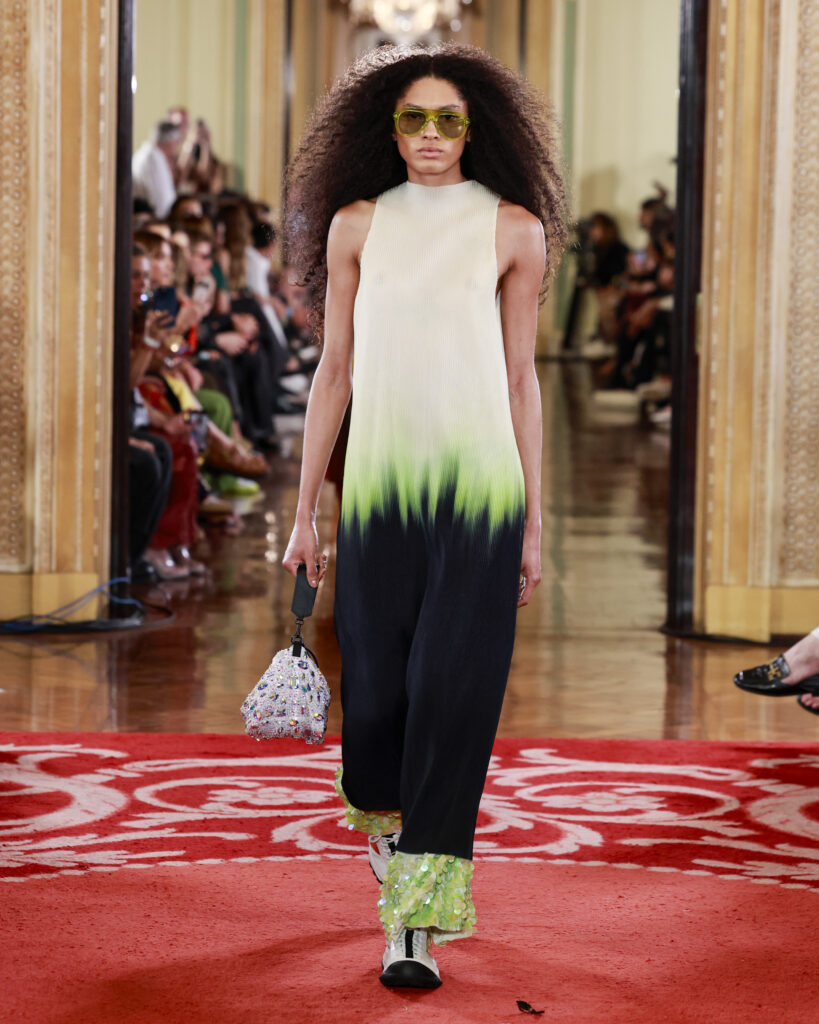
Materials, as always, are central. Linen, silk, raffia, jute, a material that insists on tactile and contact. Pirarucu leather, already developed by the brand years ago, appears not as a novelty, but as a continuation of research that articulates sustainability and sophistication. There is an ethic that runs through design, but that never becomes empty discourse: it materializes in the choice, in the finish, and in the possible duration of these pieces. Rio's sensuality, in turn, is not a caricature: it's construction. Transparencies, cutouts, minimal bikinis do not operate only as an exhibition of the body, but as an affirmation of a specific relationship with it: free, solar, self-aware. The styling reinforces this idea by mixing sandals, sneakers and hybrid accessories, as if the beach and the city were the same expanded territory.
In the end, the parade is built like a landscape in motion. A Rio de Janeiro that is not just a scenario, but a system of thought. And perhaps that is precisely where Osklen's strength lies: in its ability to transform place into language, and language into permanence.