
Guccicore: plurality as a language of style
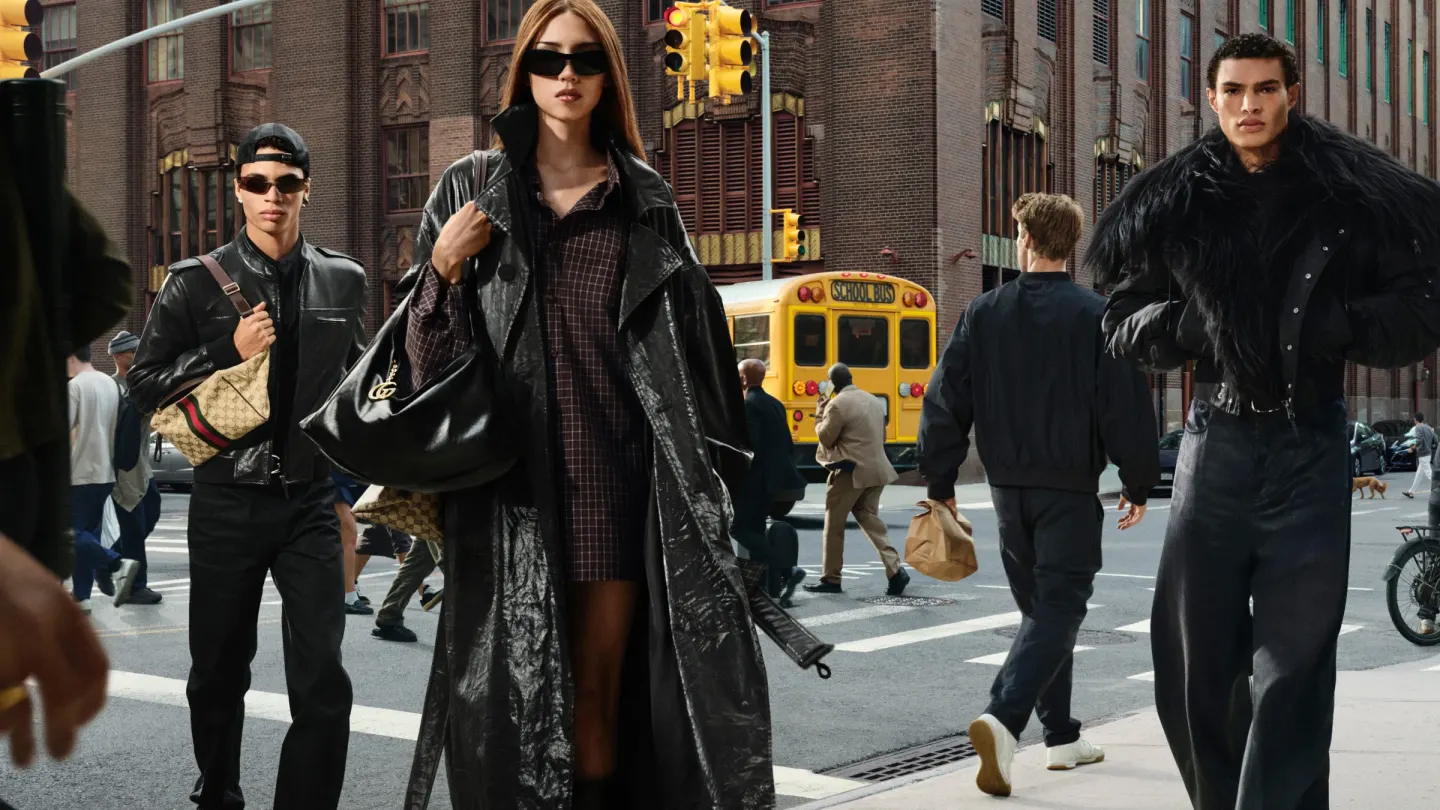
Between corners, stations, façades and intersections, unknown bodies share space without necessarily sharing the same stories. From this coexistence, Gucci sets out to present GucciCore, a campaign photographed by Peter Funch in New York, where fashion appears as an expression of the individual
Words by
Words by Sarah Rocksane Araujo
Editorial, Fashion and Beauty · October 22, 2026
Instead of isolating a figure in an idealized setting, the images bring together groups of people, styles and distinct ways of dressing, drawing the brand’s language closer to the diversity that defines the metropolis. The result is a collective portrait in which each person preserves their singularity while taking part in a larger composition. The city stops being merely a backdrop and becomes an active element of the narrative, with its multiplicity of codes, rhythms and presences. This choice dialogues with Funch’s research on the relationships between the individual and the collective in urban spaces, turning the campaign into an observation of how we present ourselves to the world and how our identities coexist with those of others. In GucciCore, style does not rely on a single image of desire, but on the possibility of gathering differences within the same landscape. Fashion, after all, also manifests in these everyday encounters, when one silhouette crosses another, a code is reinterpreted and an unexpected combination gains meaning in the movement of the streets.
Originally presented in May, at a show held in Times Square, the GucciCore collection proposes to investigate what sustains the language of a fashion house beyond fleeting trends. The selection gathers essential wardrobe pieces, such as the peacoat, the trench coat, the suit, the essential shirt, and the pencil skirt, building a clothing base that combines functionality and identity. They are recognizable items, associated with different contexts of everyday life, but when filtered through Gucci's eye, they cease to be merely practical solutions and instead assume a distinct visual signature. The proposal is to understand the essential not as a synonym for neutrality, but as a territory of possibilities. A coat can structure the silhouette, a shirt can serve as a starting point for various compositions, and a suit can move between formal conventions and individual expressions. The persistence of these pieces in the fashion imagination reveals their capacity to adapt, crossing decades and cultural transformations without entirely losing relevance. By placing them at the center of the collection, Gucci revisits the fundamentals of dressing to observe how they can continue to produce meaning in the present. The essential wardrobe does not need to be uniform, nor does it have to adhere to the idea that practicality requires aesthetic restraint. It can accommodate different bodies, styles, and interpretations, becoming an open structure to the personality of the wearer.
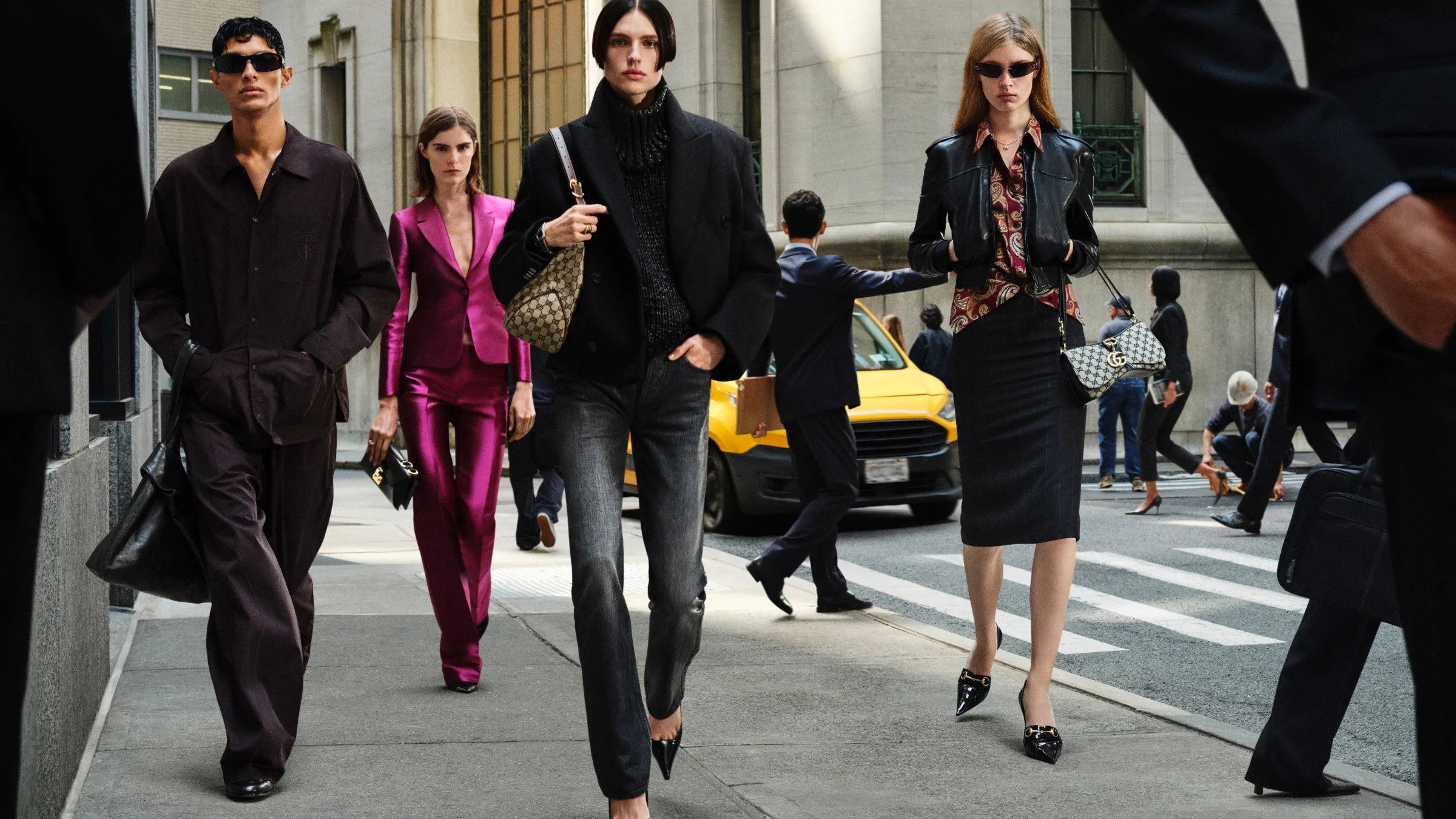
It is precisely at the intersection of functionality and Italian glamour that GucciCore finds its main creative tension. On one side, pragmatic pieces built to accompany daily life and span different situations; on the other, the elegance and expressiveness that belong to the brand’s historic repertoire. This combination prevents the essential from being reduced to a minimalist formula or to a set of universal items without identity. In fashion, simplicity is also a construction: it depends on cut, proportion, material choice, and the way each element relates to the body. The trench coat and the suit carry codes associated with formality, yet they can acquire new readings when placed in compositions that escape conventional expectations. The pencil skirt and the shirt, in turn, reveal how traditional pieces remain open to interpretations that follow changes in behavior and personal expression. The collection seems to acknowledge that the contemporary wardrobe must respond to different demands without erasing the contradictions of its wearer. We are, at the same time, pragmatic and expressive, attentive to functionality and interested in what distinguishes us. Dressing occurs in this interval, where clothing must work, but also communicate. By bringing these two registers together, Gucci turns the essential into a language that does not rely on excess to assert its presence, yet does not renounce the symbolic power of elegance.
Under the artistic direction of Demna, the campaign also invites us to consider a maison's identity as a language constantly negotiating with the present. Founded in Florence in 1921, Gucci built its trajectory from Italian craftsmanship, creativity and the ability to turn references into recognizable codes. Revisiting wardrobe fundamentals is, in this sense, a way to observe what remains when fashion cycles accelerate and images multiply. GucciCore proposes not only a selection of versatile pieces, but a reflection on how a brand establishes continuity without relying on a literal repetition of its past. Peter Funch's photography reinforces this idea by shifting the focus from the isolated piece to the coexistence among people. In New York, a city marked by the overlay of cultures and styles, identity does not present itself as a fixed image, but as something that forms in contact with the environment and the other. Each individual participates in the scene without needing to disappear within it. This plurality offers a contemporary reading of luxury, less restricted to the idealized image of a consumer and more attentive to the different ways of incorporating an aesthetic language. The value of a piece lies not only in its origin or immediate recognition, but also in the possibilities it opens when it becomes part of someone's life. It is in this space between the brand's signature and the individual interpretation that clothing finds part of its vitality.
Complete TV · Reels
Caos e ordem, do compositor tOmO
See on InstagramFrom Complete



More from Sarah Rocksane Araujo
View profile
Latest from Complete
 BeautyISDIN Fusion Water Magic: sun protection with lightness and technology
 FashionSPFW N61: Apartment 03
 The CoverIn the beginning, we couldn't even use the word handicraft.
 DesignTomie Ohtake House‑Studio presents Zanine Caldas
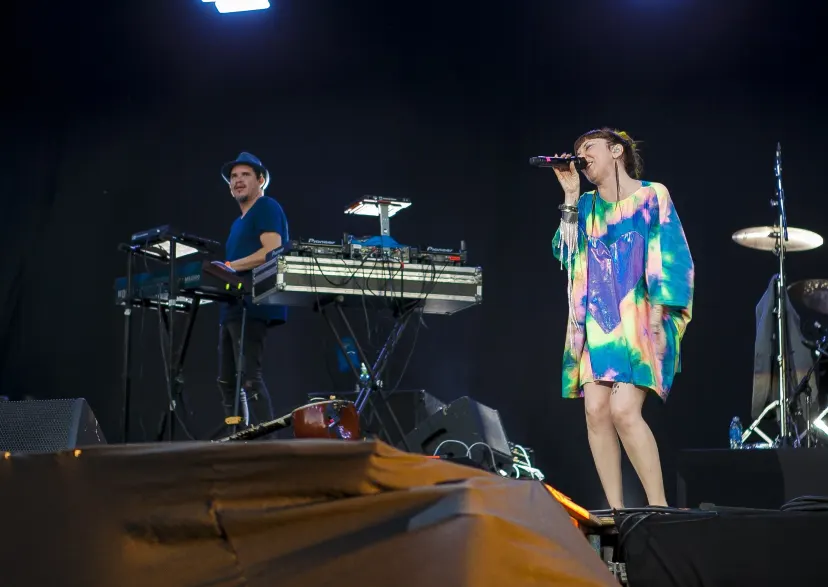 CultureThievery Corporation, 30 years: the Washington duo that originated in bossa nova
 The CoverBrazil still gives little recognition to genuinely Brazilian authorial fashion.
 InnovationLight has become a building material