

The paths of Deco Adjiman
The show brings together previously unseen works that move between sculpture, installation and writing, reaffirming Adjiman's vocation for working the border between languages.
Words by
Words by Sarah Rocksane Araujo
Editorial, Fashion and Beauty
Listen to this story
From 2 August to 24 September 2025, Galeria Luis Maluf, in São Paulo, presents the exhibition Chão é outra palavra para voo, Deco Adjiman's first solo show in the space, curated by Ana Carolina Ralston. The title, almost a riddle, suggests a paradox: the ground, normally tied to weight, to gravity and to limit, is summoned here as a surface of departure, a springboard for the imagination. The show brings together previously unseen works that move between sculpture, installation and writing, reaffirming Adjiman's vocation for working the border between languages. The central proposal is to think displacement as aesthetic material. To walk, to wander, to roam: verbs that, in his work, become artistic practices.
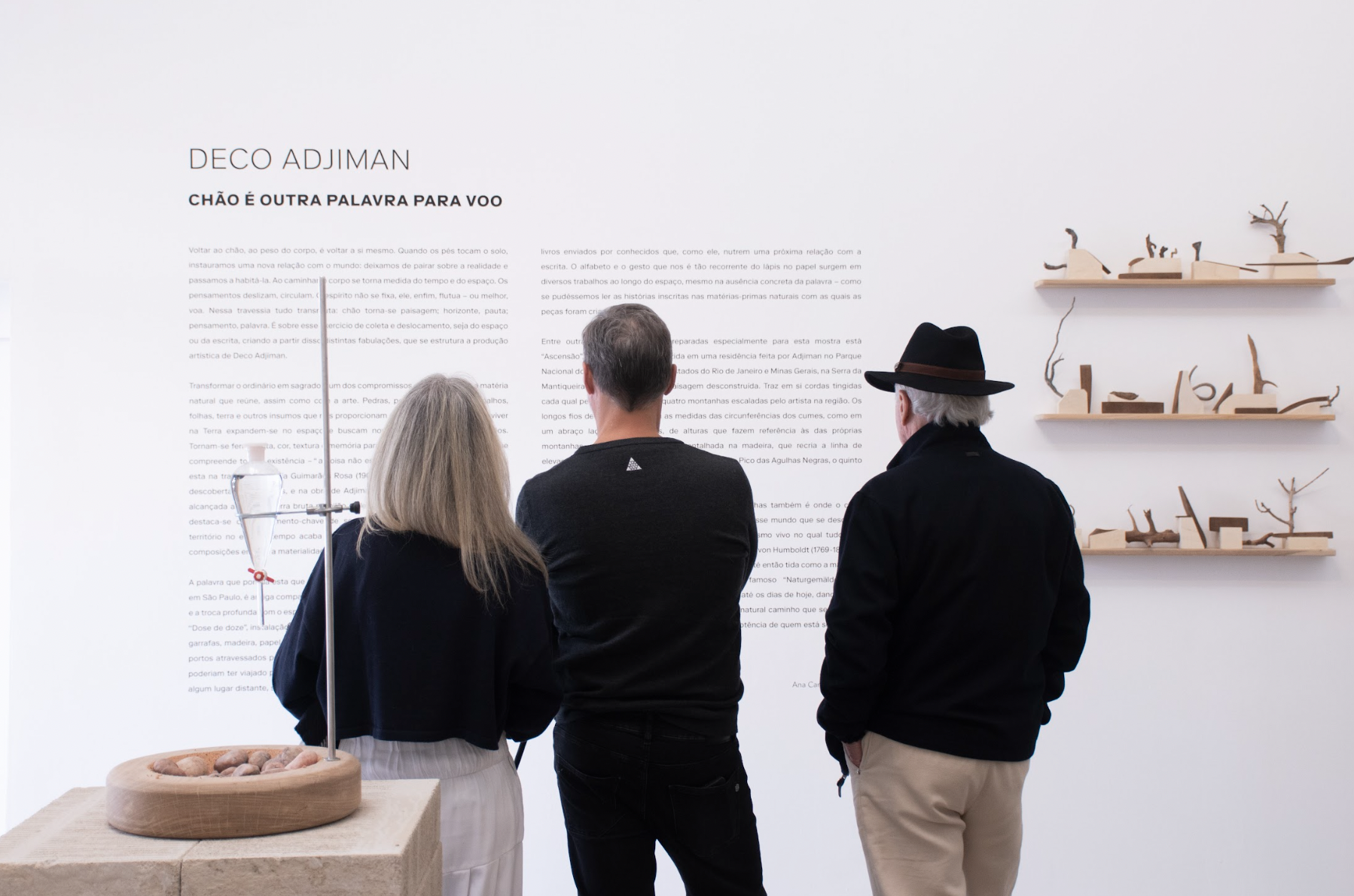
At the entrance, the installation Dose de doze sets the tone. Twelve bottles hold literary passages chosen by friends of the artist. The gesture is simple and symbolic: memories and readings become liquids preserved in glass vessels. The book here abandons its function as an object to be read and takes on the condition of relic, of shared gesture. It is an exercise in affection and community, in which word and object merge.
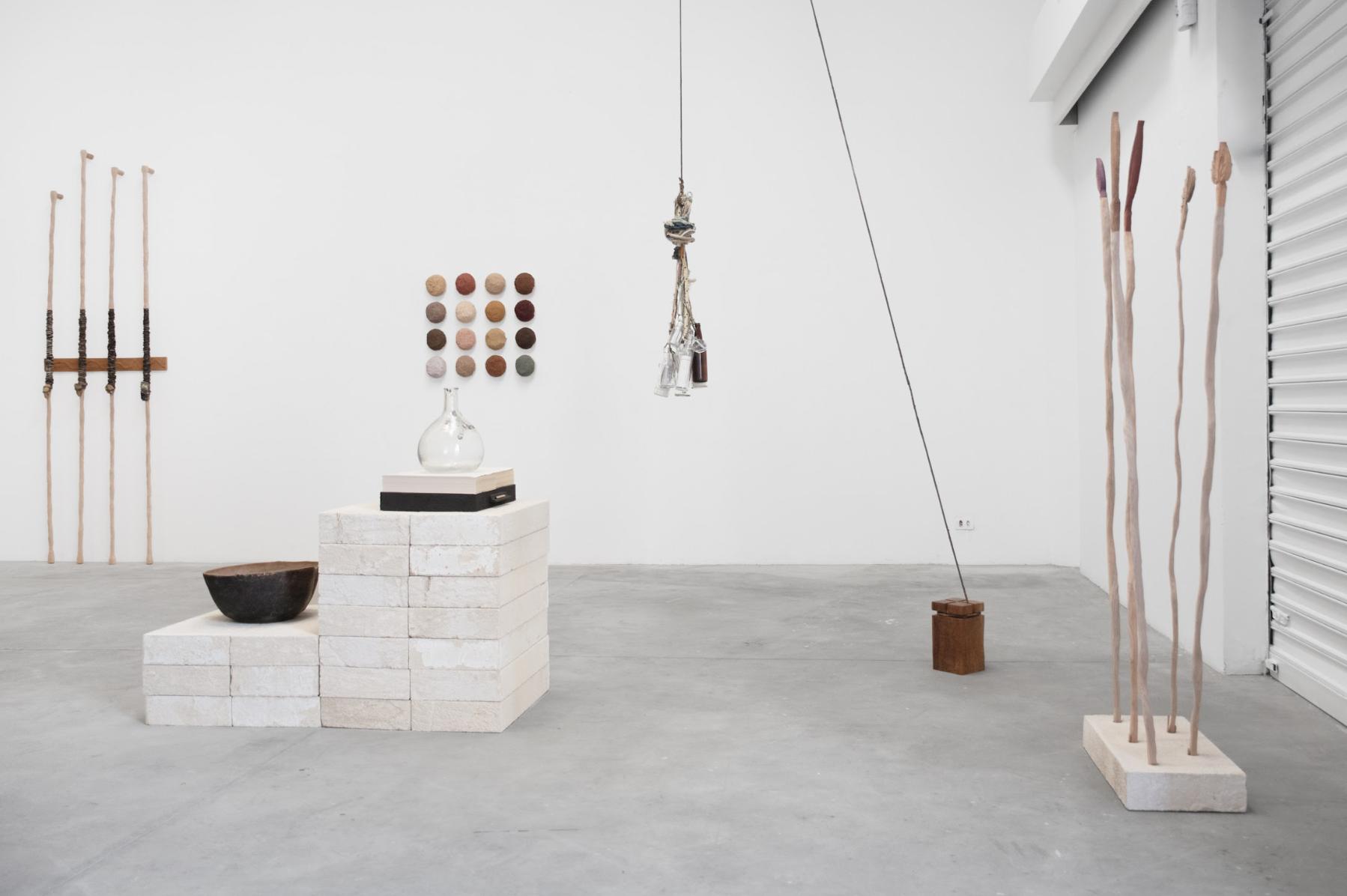
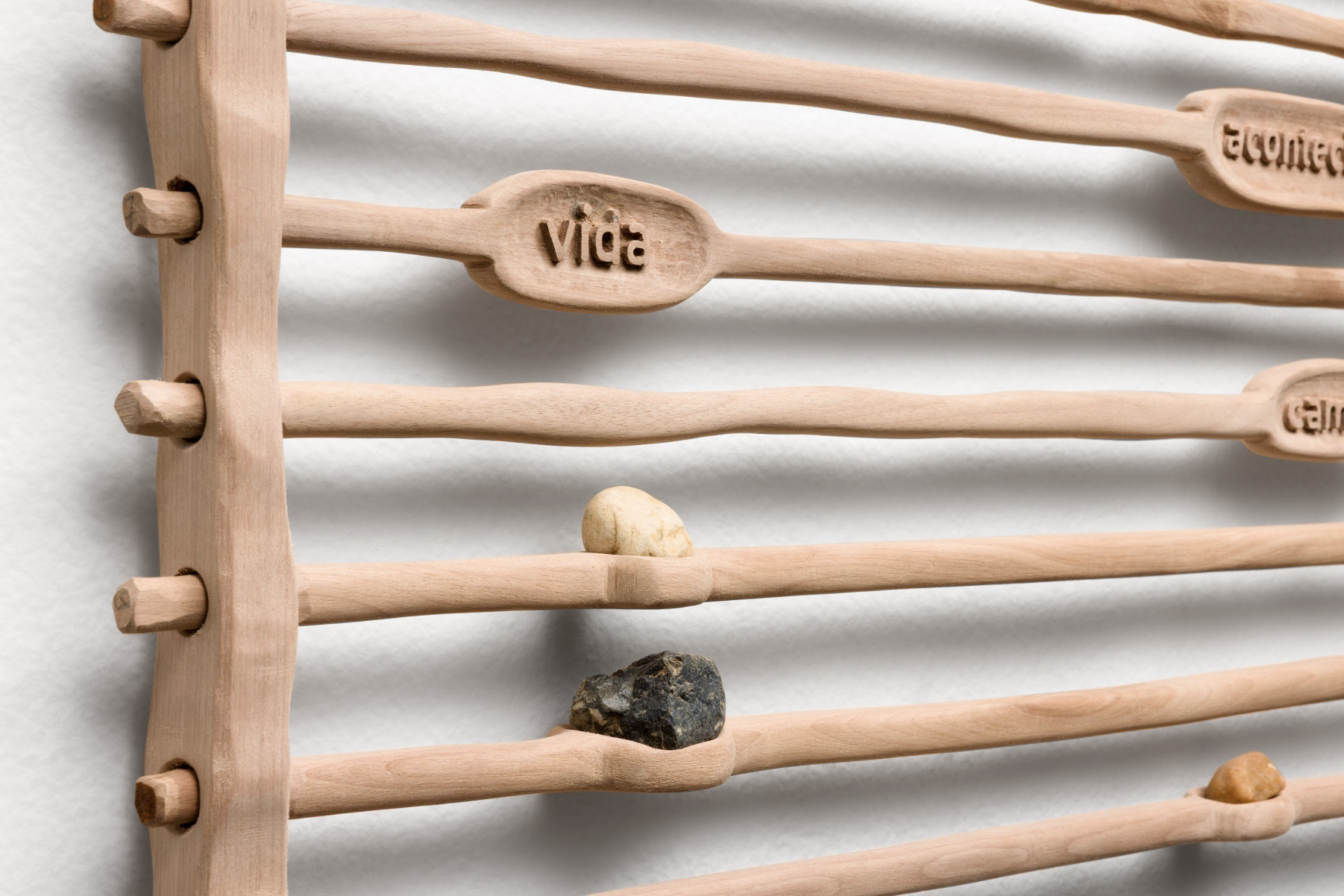
Adjiman is known for his ability to turn natural materials, stones, leaves, branches, earth, into art. But his gesture is neither mimetic nor ornamental. On the contrary, it is an exercise in listening to the landscape. Every material carries within it a memory of place. Displaced into the gallery, it carries the weight of the walk that collected it, of the geological time that shaped it, of the subjective experience that transformed it. In Chão é outra palavra para voo, that dialogue intensifies. The artist does not merely present objects, he proposes subjective geographies: cartographies that cannot be reduced to maps, but that translate experiences of displacement and of belonging.
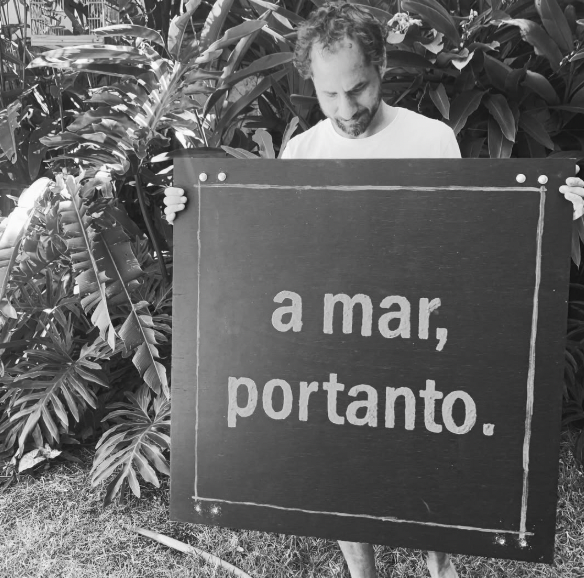
Born in São Paulo in 1979 and trained in Social Communication at FAAP, Deco Adjiman built his path as artist and poet exploring the bond between word and image. In earlier shows, such as “eu,mesmo” (2016) and “ps.: nos achamentos do chão também foram encontrados os mistérios do voo” (2022), his fascination with translation was already announced, not only between languages but between forms of language.
Interview: a poetics of wandering
Your work often starts from raw objects found on walks. How does that moment of “encounter” between you and the material happen? What decides that an object can become a work?
Afterwards, in the studio, it unfolded in a way rather different from what I had thought. But it was a walk that already began with some intention. Other times I walk only for the walk, for the exercise. I think that in walking, above all alone and for long stretches, we enter a kind of research into the subjective, into understanding our own interior. Tiredness also stirs certain movements in thought. And it is in that process that I develop ideas, creating stories to tell later. I have, for instance, a series of works called Pinturas de Paisagem, which was born precisely from that: from the idea of painting the landscape I had walked through. For that I always use elements I find along the way, such as stones and earth, from which I extract the colour to make the paint. Then I apply that material onto supports, usually wood.
You speak of wandering and drift as artistic acts. How does the act of walking shape your eye and influence the rhythm of your work?
The time of walking is slow. It is not an activity I do in a hurry, or running. It is not a sporting physical activity, about performance. I am not after performance. The time is the time of my body, and I think that, in a way, is reflected in my practice too. Almost all the work I make myself, with the exception of a few things in the exhibition. For example, some bottles that were laser engraved, those I have made. But everything else is work I execute myself, sometimes with certain technical limitations, with the limitations of my knowledge.
I am also a cabinetmaker, but of course I have my limitations. Even so, I always prefer to do it myself rather than pass it to other people. I think that question of time and rhythm is clear in the work. You can tell there was a hand there, you know? You feel the presence of the hand in the work, it is something very un-industrial, very organic. I look for organic forms, so I believe that time of life, of walking, of nature, also appears in what I do.
In the work “eu,mesmo” (2016) you explored translation between languages and between forms of language. How did that enquiry develop until it reached the current exhibition, “Chão É Outra Palavra para Voo” (2025)?
Well, in my path I come first from an interest in literature. As a consumer of art, what I consumed my whole life was literature. Only later did I develop an interest in the visual arts, and that is not so long ago, around ten years. So my artistic practice has that span: ten years. In the beginning it was a practice closely tied to literature, in which the word was very present. That exhibition you mention, eu, mesmo outro, was an intentional project of translating poetry into visual language, into the visual arts. They were poems, or appropriations from literature, that I carried into materiality.
Over time I moved somewhat away from the word and turned more to wood, to the object, to earth. But in this current exhibition I decided to bring the word back, and it comes back strongly. There is a good deal of work with text, at least two pieces that repeat that wish to translate the poem literally. There is, for instance, Drummond's poem No meio do caminho in a material version; a line by Fernando Pessoa; and also a kind of translation or adaptation of Grande Sertão: Veredas. They are quotations from authors I live with and who run through my practice. And beyond them, other ways of using literature in the visual arts, something that has always interested me a great deal and that I have been exploring, now returning to explore with the word itself, directly.
It is hard to say, because it is a slightly unstable and uncertain thing, isn't it? Sometimes I take a walk with some intention already somewhat set out. For example, I was in the Itatiaia National Park, on an artistic residency about three months ago, and there are high mountains there, some of the highest peaks in Brazil. I went intentionally with a very long piece of string, with the idea of climbing to those peaks and giving a kind of embrace using that string. So I went with that material, gave that embrace, took a little of the earth and, from the top of the mountain, also took a stone.
Yes, it is also somewhat fluid, a balance between my limitation in making and what the material allows me, isn't it? Starting with the use of wood, for example: each wood makes a certain kind of making possible, a different way of acting on it. Now I have also been experimenting a good deal with painting in natural pigments. I am not a painter in the more classical sense, but I have been learning that each kind of earth allows a distinct way of painting. Often it is only a simple filling of the space that the earth makes possible; at other times it even allows you to write with it.
So I end up writing some words with earth. I think the form adapts according to the material. I use a great deal of what is at hand. I rarely go after something specific, as in “I need that material”. I work a lot with reused wood, left over from the workshop; with things I find in skips, on beaches or in the bush. There is that idea of buying as little as possible, so as not to have so much impact, but also because I live with those materials, and they end up contaminating me, directing me. They themselves indicate where they want to go. I think it is a bit like that: to perceive the material and let it lead the work.
The act of walking as subjective research recalls artistic traditions such as the flâneur. Which references, artistic or literary, feed that aspect of your work?
Yes, Charles Baudelaire is certainly a great reference. I confess I do not know that German movement, but I like the French poets very much, especially Baudelaire and Arthur Rimbaud. I think Rimbaud has a unique force: he wrote very young, and in such a rupturing way. Then he brings all that question of wandering, of drift, of the journey. On ceasing to be a poet, he makes a pilgrimage through Africa until he becomes an arms dealer. His biography is very interesting, and he dies extremely young. Beyond that, figures such as Gandhi are also inspirations for me, they always were a reference.
When I began to study walking, I came upon the Salt March, a very significant episode in his path. Among the books that formed me is certainly Grande Sertão: Veredas. It is a crossing, “Travessia” is the last word of the novel, which begins with “Nonada” and ends with that displacement. Throughout the saga there is that idea of the crossing. Another classic that influenced me a great deal was On the Road, by Jack Kerouac. Despite more recent criticism of the language and of the way its authors saw the world at the time, when I read the book, still young, it threw me onto the road, it gave me that wish to walk.
These days I have a reference I admire a great deal: Francesco Careri, an Italian philosopher who has studied walking and displacement in the visual arts. He put together a very interesting compendium of artists who work with walking as an artistic process. One of his books that I like a lot is Walkscapes, in which he analyses, from the beginning of humanity to today, how walking has led us, passing through nomadic peoples and a whole historical perspective.
There is a line of his that I like very much and that speaks to what we were saying about time. He says: “When we go from point A to point B in a straight line, we gain time. When we go by any other path, we gain space.” That idea of “losing time to gain space” interests me a great deal, because it expands geographical space and, in some way, internal space too.
In Chão É Outra Palavra para Voo you investigate the relationship between body and space, and how individuals project themselves onto landscapes. How did that approach take shape in the pieces of the exhibition?
Ah, I think in practically every work, and that must be some 80% of the exhibition, there is earth, there is ground. I prefer to call it ground rather than earth, because ground has that sense of the element that connects us, that holds us and that lets us walk, explore, live. So geography is present there. The landscape runs right through the work. For me, the experience of entering the exhibition is like walking through the places I walked. It is bringing that landscape into the gallery, into that space which, although not exactly a white cube, since it has some cuts, is still a more classical space for showing art. The idea is to bring the forest, the beach, the mountains. I think all of that is a little bit there.
Deco Adjiman - Chão é outra palavra para voo
2 August to 24 September
10am to 7pm
Luis Maluf Galeria
Rua Brigadeiro Galvão, 996
Barra Funda
São Paulo, SP Brazil
Complete TV · Reels
Maja Petrić: a artista que escreveu a própria inteligência artificial
See on InstagramFrom Complete

More from Sarah Rocksane Araujo
View profile
Latest from Complete
 FashionFORCA Studio at SPFW N61: Forca X, Bridgestone tire and punk leather
 DesignTomie Ohtake House‑Studio presents Zanine Caldas
 The CoverIn the beginning, we couldn't even use the word handicraft.
 CultureThievery Corporation, 30 years: the Washington duo that originated in bossa nova
 InnovationLight has become a building material
 The CoverBrazil still gives little recognition to genuinely Brazilian authorial fashion.
 BeautyBORNTOSTANDOUT arrives in Brazil