

ArPa 2025 reaffirms São Paulo as the epicentre of the Latin American art market
Between 28 May and 1 June, the Mercado Livre Arena Pacaembu hosts the fourth edition of the ArPa art fair. Established as one of the main gatherings of the contemporary art circuit in Latin America, ArPa brings together around 100 artists and more than 60 galleries from 14 countries.
Words by
Words by Caíque Nucci
Editor-in-Chief
Listen to this story
Between 28 May and 1 June, the Mercado Livre Arena Pacaembu hosts the fourth edition of the ArPa art fair. Established as one of the main gatherings of the contemporary art circuit in Latin America, ArPa brings together around 100 artists and more than 60 galleries from 14 countries. The event expands its international reach while keeping Brazilian production and the strengthening of networks between artists, galleries, curators and institutions as its focus.
Since its creation in 2022, the fair has adopted a precise curation and built a programme that departs from the logic of mass display, favouring the quality of presentations in formats close to solo shows or small group exhibitions. The model has attracted galleries committed to artistic research and to more sensitive curatorial practice, above all from Latin America.
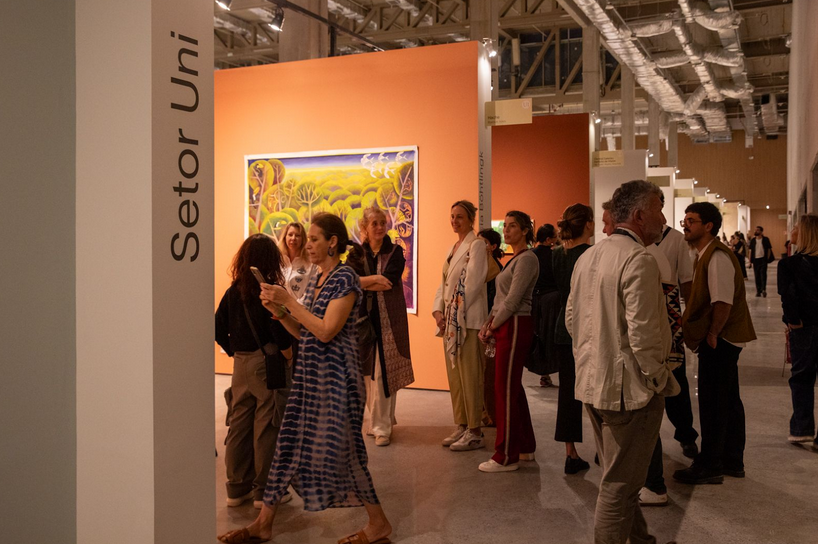
This year's edition celebrates the return of galleries such as Ruth Benzacar (Argentina), marking its 60th anniversary, and Casas Riegner (Colombia), alongside important debuts such as Constitución (Argentina), OMR (Mexico), Coral Gallery (Miami) and Formatocomodo (Spain). It also marks the return of names such as Isla Flotante and Campeche, reinforcing ArPa's breadth and its articulation in the regional context.
Alongside institutional participation, the fair runs the Prisma Programme, which connects the gallery circuit to collectors linked to institutions such as LACMA, the National Gallery of Art and Tate Modern. Figures such as Eugenia Braniff (Colección FEMSA) and Laura Hakel (Colección Ama) will be present, reflecting the degree of international articulation of the programme.
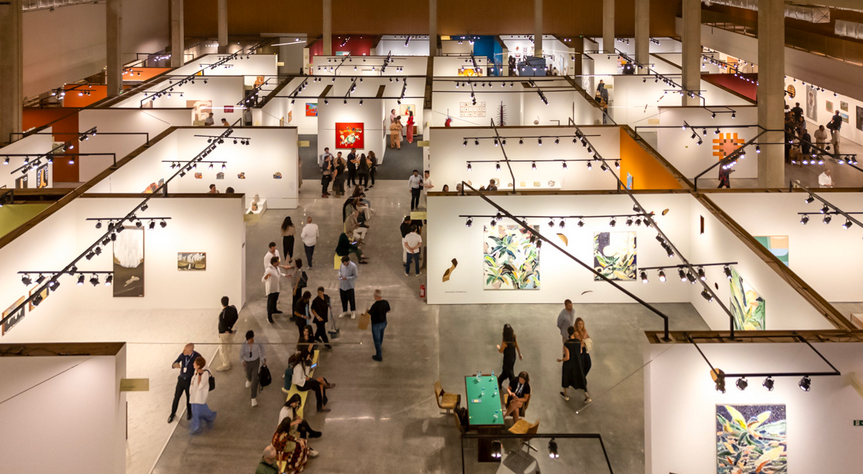
ArPa's curation is formed by a committee responsible for selecting the participating galleries on artistic criteria and on the diversity of their practice. National presence remains the fair's structuring axis, with names such as Mendes Wood DM, Almeida & Dale, Raquel Arnaud, Simões de Assis and, for the first time, Luisa Strina and Martins & Montero.
“We limit the number of artists per stand to allow a deeper reading of each proposal”, says Camilla Barella, the fair's general director. “ArPa is not structured as a market of volume, but as a platform of research, valuing the multiplicity of voices.”
The economic context favours the sector's growth. According to the Art Basel and UBS Art Market Report 2024, South America appears as one of the most optimistic regions in the world: 87% of Brazilian gallerists expected sales growth in 2024. The Sector Survey of the Visual Arts Market in Brazil indicated a volume of R$2.9 billion in 2023, a growth of 21% on the previous year. ArPa will release its own updated survey during the week of the event.
Sections in dialogue: UNI and Base
The 2025 edition marks the fair's physical expansion, which will also occupy the Mercado Livre multi-sport hall. There will be the UNI Section and the Base Section: two spaces devoted to specific curatorial proposals.
UNI, curated by Ana Sokoloff, presents twelve solo shows, six from Brazilian galleries and six international, with artists such as Ventura Profana (Formatocomodo), Laercio Redondo (Galleria Continua) and Ad Minoliti (OMR) standing out. The exhibitions address themes such as power, belonging and social ecologies in times of crisis.
The Base Section starts from the principle of pedagogy as artistic practice. In a gesture of continuity and collaboration, artists such as Dalton Paula, Dora Longo Bahia and Santidio Pereira invite peers with whom they share formative relationships to co-sign both the exhibition projects and the public conversations during the fair.
Brazilian presence and a vocation for exchange
The list of Brazilian galleries taking part includes established and emerging names from different regions of the country. The territorial and aesthetic breadth of the projects presented shows the vitality of the national scene and its capacity to speak with international practice. Alongside ArPa, the MADE fair, devoted to collectible design, reinforces the crossing between art and material culture, fostering an integrated and contemporary ecosystem.
With focused curation, an international programme and attention to market flows, ArPa continues to affirm its importance as one of the most significant platforms for the development of contemporary art in Latin America.
Complete TV · Reels
O artista uruguaio Mauro Cosenza @mauro_cosenza, formado no circo e no teatro físico, apresentou Neo Botanica na Load Gallery @load.gallery
See on InstagramFrom Complete



More from Caíque Nucci
View profile
Latest from Complete
 FashionFORCA Studio at SPFW N61: Forca X, Bridgestone tire and punk leather
 DesignTomie Ohtake House‑Studio presents Zanine Caldas
 The CoverIn the beginning, we couldn't even use the word handicraft.
 CultureThievery Corporation, 30 years: the Washington duo that originated in bossa nova
 InnovationLight has become a building material
 The CoverBrazil still gives little recognition to genuinely Brazilian authorial fashion.
 BeautyBORNTOSTANDOUT arrives in Brazil