
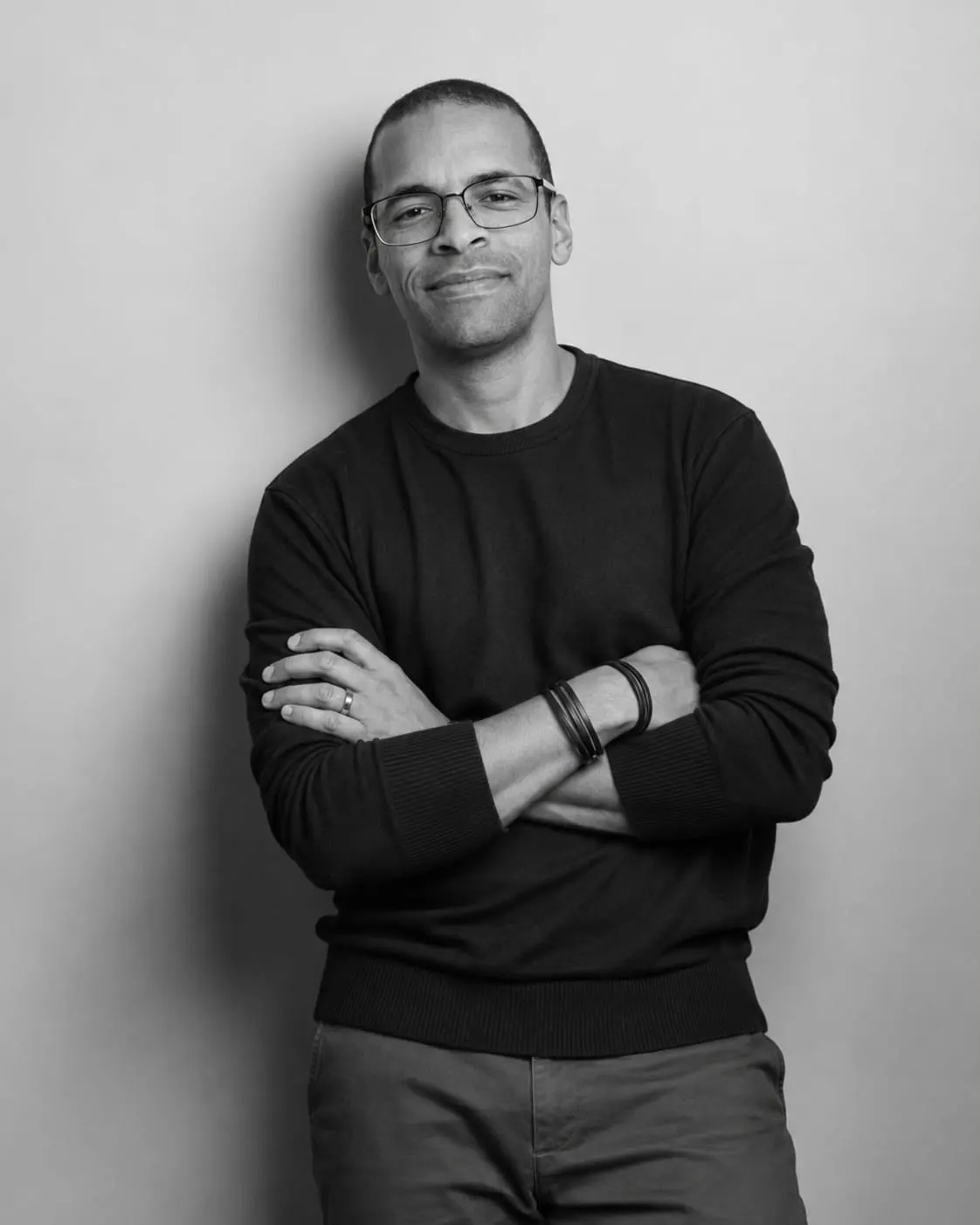
Diego Fernandes and Indiqz: the recommendation list that was born in the early hours, with a child on his lap
After nearly two decades at large companies, the ABC advertiser created an app where a recommendation is valued for the name of the recommender, not for the ad of the payer.
Words by
Words by Caíque Nucci
Editor-in-Chief · November 12, 2026
It was in the early hours, with his son Noah still small in his arms, that Diego Fernandes realized the magnitude of a minor problem. He needed to schedule an appointment with an allergist and knew someone had already recommended a good professional, but he couldn't recall who or where that information was. It could have been in a WhatsApp conversation, an Instagram message, or lost in some other channel. “There are so many places where we look for references that we lack a single place where all the references you need are gathered,” he recalls.
That night Indiqz was launched, a recommendation network where each suggestion arrives with the name of the person who recommended it. The idea is old, and Diego does not hide the inspiration: mothers’ phone books, the yellow pages, the little notebook that held the contact of the pediatrician and the trusted electrician. “No matter how old it is, it had a place. Today, because of the internet, everything is scattered.”
A career designed for inside companies
Diego is 39. He was born in Santo André, spent most of his life in Ribeirão Pires and now lives in São Bernardo do Campo, in the Greater ABC region. He holds a degree in Advertising and Propaganda from the Methodist University of São Paulo and a postgraduate degree in Marketing Management from FAAP. He never wanted to create ads: his interest lay in corporate marketing, planning, and client relations. He worked at the rental companies Hertz and Sixt, where he dealt with loyalty and rewards programs, at UPS in market intelligence, and since 2017 has been active in the Indeed and Glassdoor ecosystem, handling consultative sales, digital platforms, and business relationships.
Entrepreneurship was not in the plans. “I always imagined myself as a marketing director of a multinational,” he says. What changed was the routine after Noah was born. The desire for more time at home and a daily schedule adjusted to the family revived an old taste for strategy and planning, turning it into a personal challenge: to be responsible for a product from start to finish. “Many people said it wouldn’t work. So I started to challenge myself as well.”
The fall that taught the way
The idea began to take shape in September 2024. Diego set out knowing nothing about app development or company formation. He studied what a minimum viable product was, the legal and accounting side, no‑code tools, and solicited quotes from large firms just to understand what the maximum deliverable would be and, from that, what fit the budget. Before writing a single line of code, he hired someone to create the name and visual identity. Each materialized step became a finish line. “Each time I completed something, I felt closer to launching it.”
The first development, outsourced in 2025, never reached completion. Missed deadlines, partial deliveries and a project that had to be practically rebuilt and that, in his words, “only served as a lesson in how not to do it.” Instead of abandoning the idea, the founders decided to restart on a more robust technological foundation. The turning point came from a conversation: when he explained the problem to a friend, Diego heard that her cousin was a developer. Felipe Menezes joined the project and today is co‑founder and head of technology. “The professional who helped us rebuild Indiqz came through a referral that was already within our own network. We live, in practice, the problem the company was created to solve.”
Trust as a product
The Indiqz was officially launched on June 8, 2026, for iOS and Android. In September it counted 434 registered users, more than 650 recommendations made, and 540 companies, professionals and establishments on the platform. In addition to Diego, who leads strategy, commercial, partnerships and fundraising, the company includes Tais Vieira Prado, co‑founder responsible for the product and user experience, and Felipe Menezes, overseeing technology. Indiqz also took part in Ginga Afrotech, a Sebrae for Startups initiative focused on innovative businesses.
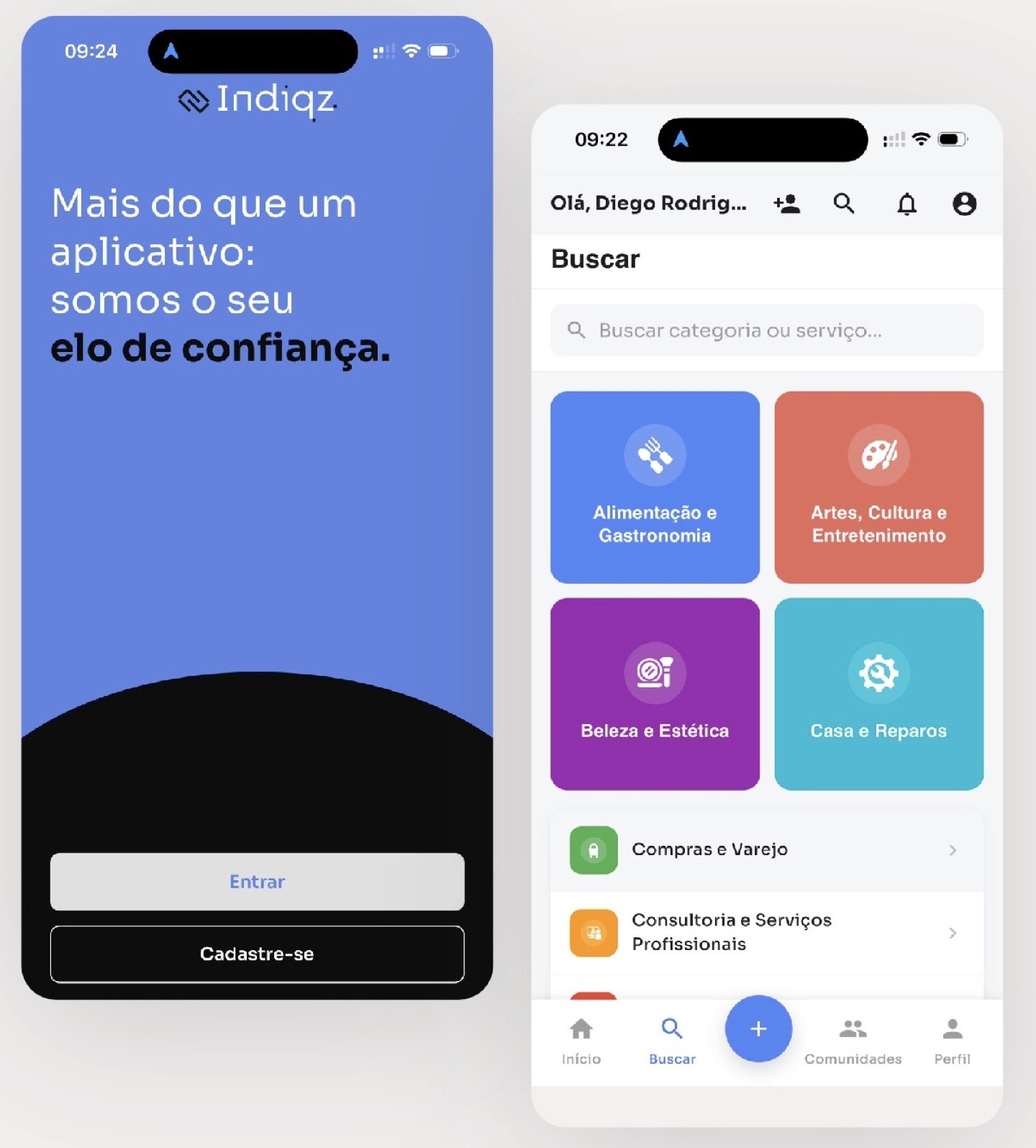
The focus is on professionals who live by word of mouth and rarely have a storefront: the daily cleaner, the electrician, the bricklayer, the hairdresser, the barber. “Today every professional also needs to be an influencer in their own field. The idea is that people are recommended for their work, not for the advertising they can afford.”
The safety, for Diego, lies in the source of the recommendation. The app shows where each recommendation comes from: a friend, a friend of a friend, the school mothers' group, a neighborhood community. “Trust is in your relationship with that person. If you have a friend there who studied with you, you can send a message and ask about that professional.” Without a network, he acknowledges, the app loses its meaning. “Its strength is in the communities and connections.”
Therefore growth starts small and intentionally. Indiqz was born concentrated in the ABC region, among mothers' and school communities, so that recommendations could gain density before crossing the map. Diego compares it to Facebook’s origin, which started within a university. “To grow a social network, I think this is the only way. You can burn money on influencers, but organic growth creates greater utility.”
The new phase
The first months on air served to observe where users stopped, what they did and what they omitted, as well as listening to test groups formed by building neighbors and mothers close to the family. The result is a redesigned end‑to‑end version, without the empty screens that left newcomers unsure what to do. The app now suggests the first step, such as recommending a restaurant, and adds an achievement system that ranges from the city pioneer to the neighborhood curator. “We look at this new version and it feels like a different app.”
With it also comes the plan for businesses, at R$ 9.90, featuring highlighted communities and a photo gallery so each business can showcase its own service; networks with multiple units will have conditions upon request. The update runs in the background, without taking the app offline, and the promotion, so far concentrated in the ABC, will open up to the cities where organic growth appears first.
On the horizon is artificial intelligence, with a clear limit. Diego envisions an app where you simply ask, in a conversation, for an electrician and receive three recommendations: one from a close friend, one from the neighborhood, and one from a community you belong to. The technology is already being used for the pre‑analysis of documents from companies that request a verified page, always followed by human review. “We move forward together with artificial intelligence, as long as it never strays from the community and the connections that already exist outside the internet.”
The stated goal is to build the first large Brazilian network of recommendations, with active users in every state. And, in its midst, remains the boy who gave rise to it all. “Noah will always be the spokesperson of the app.”
Indiqz can be downloaded on the App Store and on the Google Play.
Complete TV · Reels
THE IMAGE THAT RESPONDS TO HANDS, by Anton Berkasov
See on InstagramFrom Complete




More from Caíque Nucci
View profile

Latest from Complete
 FashionGuccicore: plurality as a language of style
 BeautyISDIN Fusion Water Magic: sun protection with lightness and technology
 The CoverIn the beginning, we couldn't even use the word handicraft.
 DesignTomie Ohtake House‑Studio presents Zanine Caldas
 CultureThievery Corporation, 30 years: the Washington duo that originated in bossa nova
 The CoverBrazil still gives little recognition to genuinely Brazilian authorial fashion.
 InnovationLight has become a building material