

Klára Hosnedlová presents "Echo" at White Cube with an immersive installation about time, architecture, and living matter
Exhibition at White Cube, in London, transforms embroidery, sculpture, and performance into an archaeological environment of the future
Words by
Words by Caíque Nucci
Editor-in-Chief
Listen to this story
Among metallic structures, monumental tapestries, and organically growing forms, Czech artist Klára Hosnedlová constructs in "Echo", her exhibition at White Cube Bermondsey, a total environment that investigates time as a plastic material.
Born in 1990, part of the first post-communist generation in the Czech Republic, Hosnedlová develops a practice that articulates architecture, sculpture, embroidery, and performance in site-specific installations. Her work stems from research on modern utopias in Central Europe and their contemporary reverberations, combining references to brutalism, science fiction, and the region's artisanal traditions.
In "Echo", on display until 29 March 2026, the exhibition space is converted into a sort of archaeological excavation of the future. Industrial structures and metal platforms are occupied by sandstone reliefs, hyper-realistic embroideries, and organic masses cultivated with mycelium and reishi mushrooms. The landscape suggests a post-natural scenario, where human remnants coexist with ongoing biological processes.
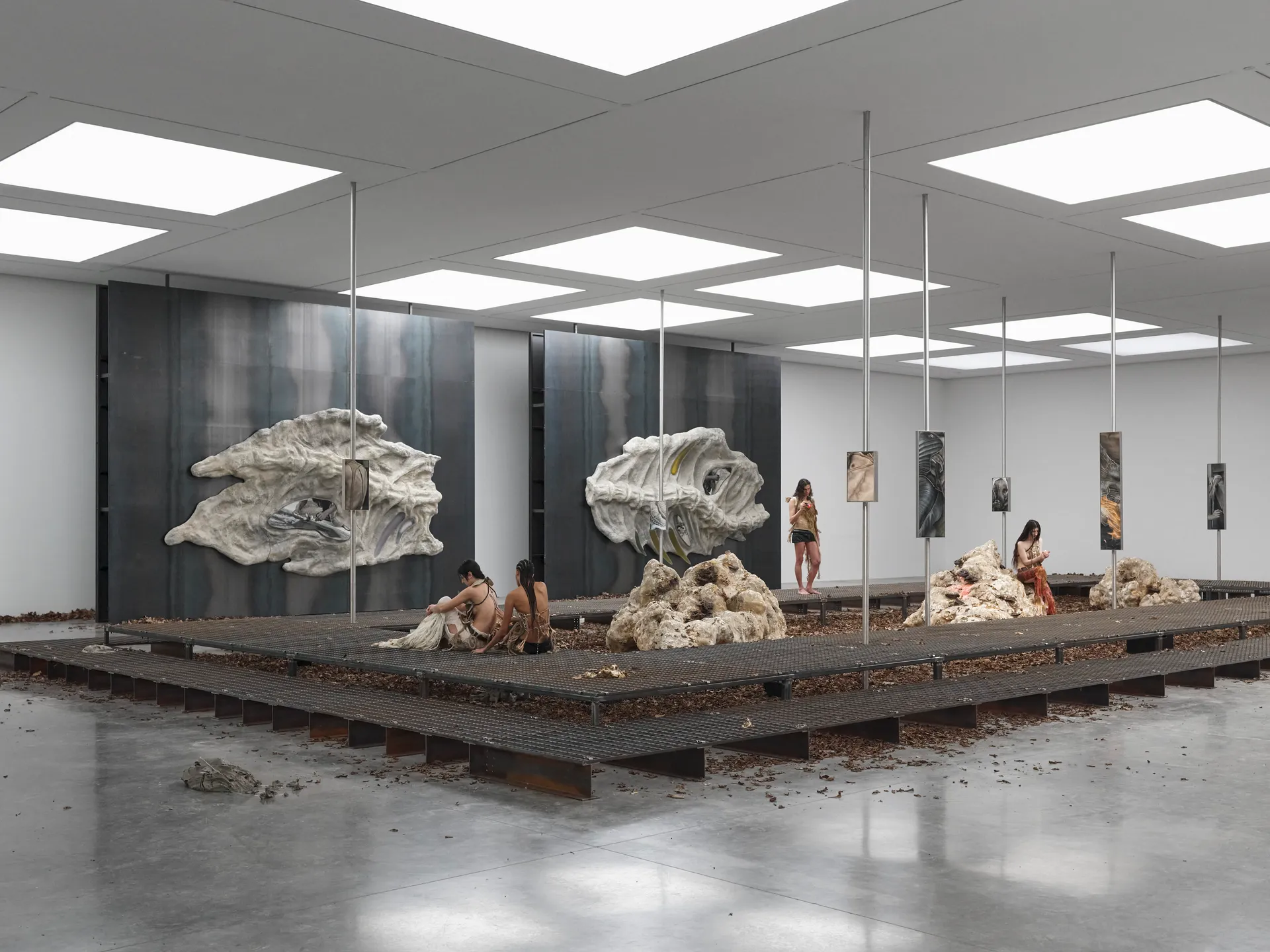
At the center of Hosnedlová's practice is manual embroidery, developed from photographs produced by the artist herself. Before each exhibition, she stages private performances within the structures she builds. These records become the basis for embroidered panels with silk or cotton thread, executed over the course of months.
The resulting images show fragments of bodies and gestures suspended in time: hands holding a lit match, fingers marking surfaces with charcoal, mouths adorned with dental jewelry. The gesture, often associated with primary technologies such as fire or drawing, appears as an instrument of memory and transmission.
Embroidery, traditionally associated with the field of crafts and the domestic, is displaced to a monumental scale and inserted into an architectural scenography. By doing so, Hosnedlová tensions the boundaries between art, craft, and spatial construction, treating the thread as a means of historical inscription.
Trained at the Academy of Fine Arts in Prague, the artist has developed a consistent research on modernist and brutalist architecture in Central Europe. In her work, buildings are understood as future archaeological vestiges, structures that will carry, for future generations, marks of collective ideologies and desires.
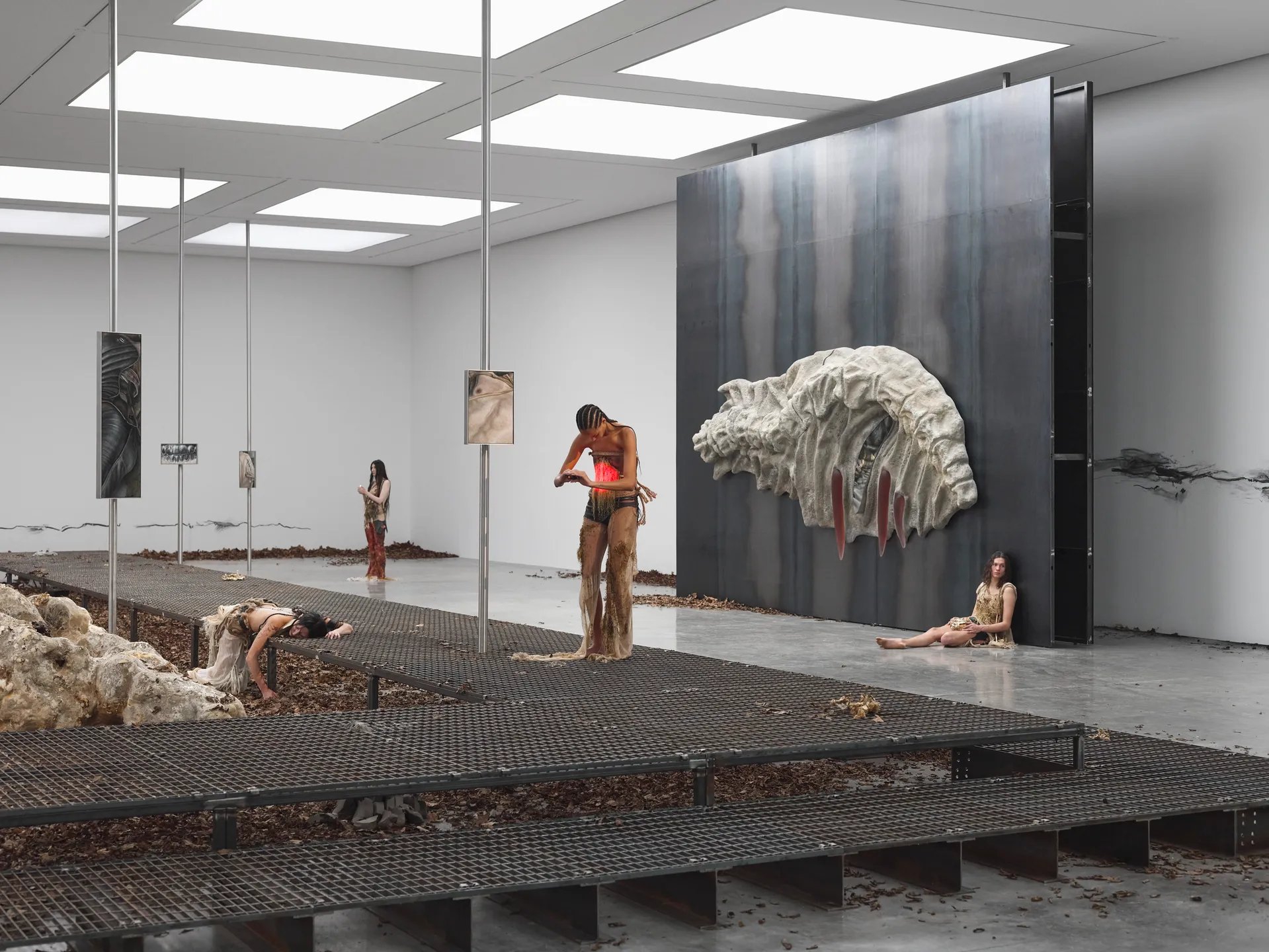
In “Echo”, this logic materializes in elevated platforms, metal walls, and sculptures with a fossilized appearance. Industrial elements are combined with natural fibers, stone, and mineralized resin. The contrast between steel and organic matter reinforces the sensation of a world in transition, where industrial past and biological growth intertwine.
The exhibition space ceases to be a neutral container and begins to operate as an organism. Fragments of abandoned costumes, scattered leaves, and marks on surfaces suggest the recent passage of bodies. Human presence is insinuated, never central.
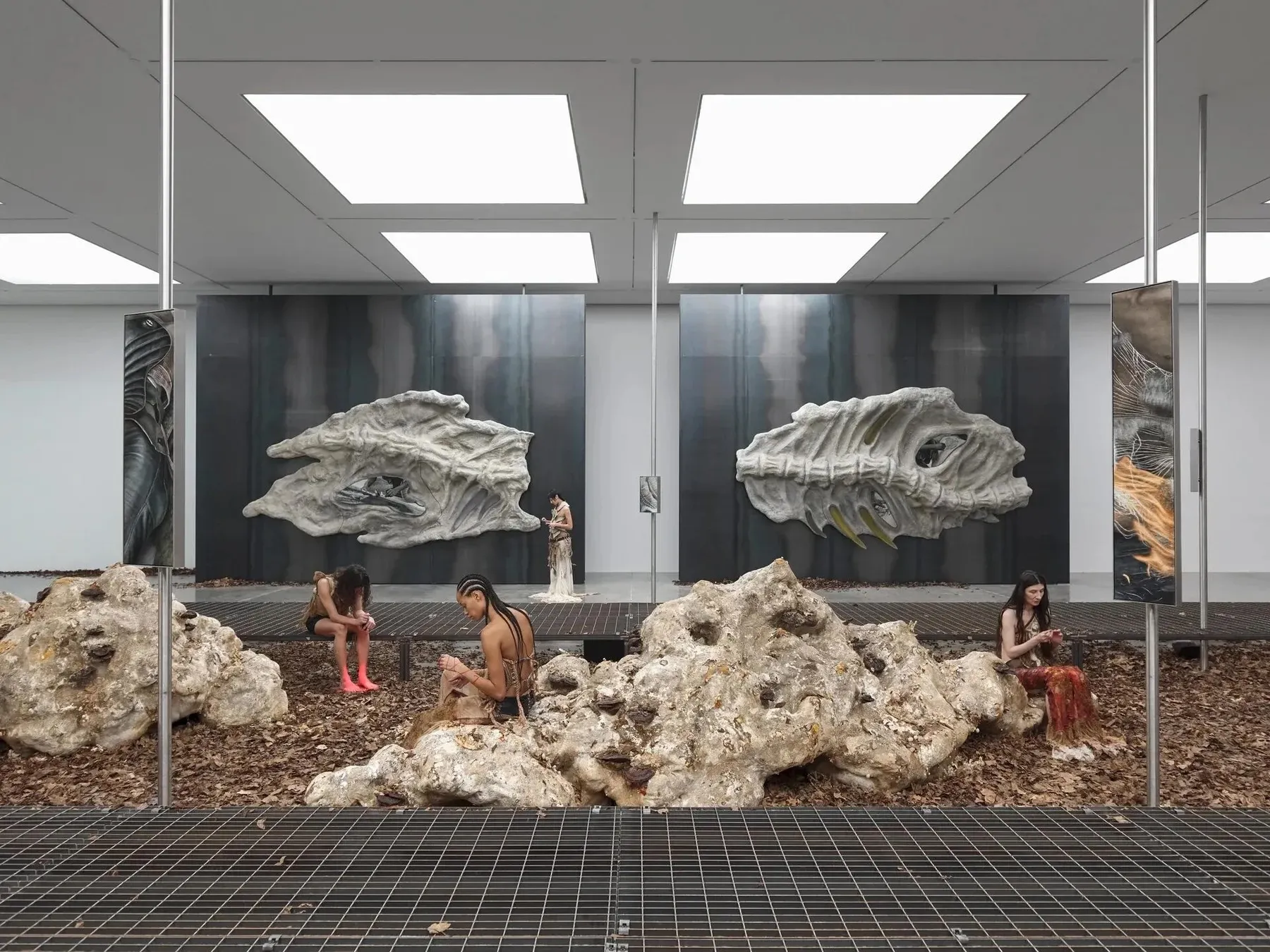
The notion of “echo” functions as a structural principle of the exhibition. Elements from previous projects reappear reconfigured, creating continuity between distinct shows. Ideas are not repeated, but transformed.
By incorporating living fungi and biological growth processes, Hosnedlová introduces time as an active agent. The work is not static: it changes, matures, and reacts to the environment. The sound, developed as part of the installation, amplifies this dimension, adding temporal layers to the physical space.
Rather than proposing a linear narrative, “Echo” suggests that time can be compressed, accumulated, and reactivated. The artisanal past, utopian modernism, and a post-human imaginary coexist on the same plane.
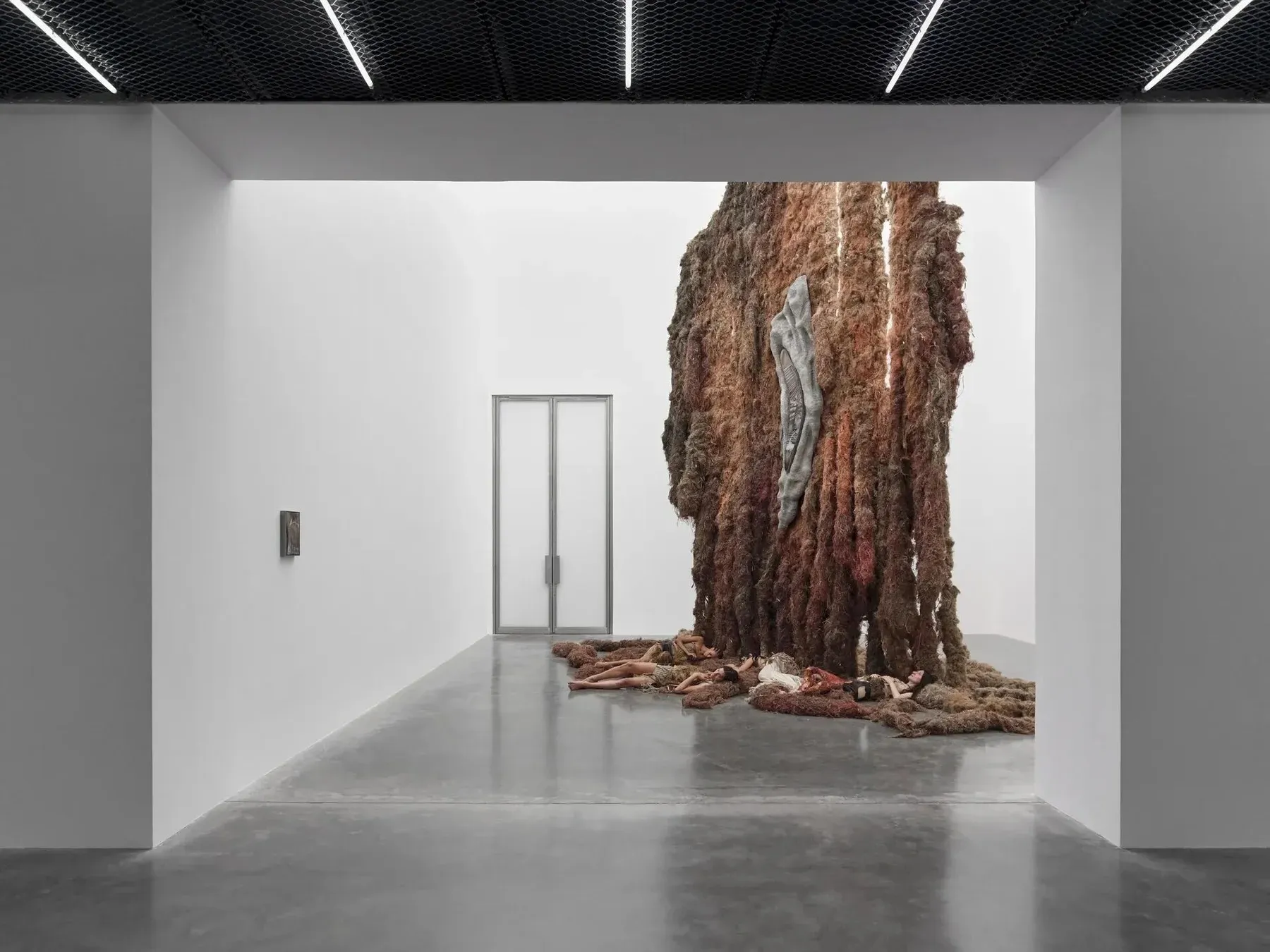
With recent exhibitions at institutions such as Kunsthalle Basel and Hamburger Bahnhof, Hosnedlová consolidates a practice that treats installation as a total environment. Each project is conceived as a closed system, where sculpture, image, and performance operate in an interdependent manner.
In “Echo”, the artist does not present isolated objects, but a territory. The installation functions as a field of tension between industrial matter and living matter, between historical memory and speculative projection.
The result is not a dystopian or celebratory vision of the future. It is a suspended space, where the visitor walks through a landscape that seems simultaneously ancestral and yet to come.
Complete TV · Reels
A IMAGEM QUE RESPONDE ÀS MÃOS, de Anton Berkasov
See on InstagramFrom Complete



More from Caíque Nucci
View profile
Latest from Complete
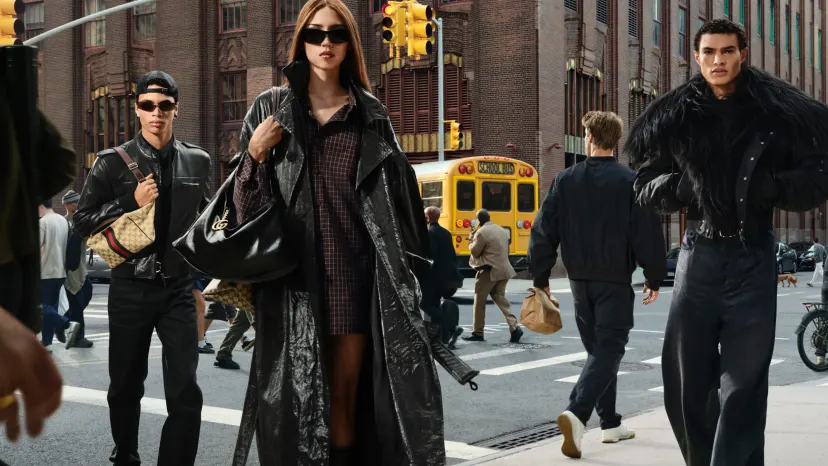 FashionGuccicore: plurality as a language of style
 BeautyISDIN Fusion Water Magic: sun protection with lightness and technology
 The CoverIn the beginning, we couldn't even use the word handicraft.
 DesignTomie Ohtake House‑Studio presents Zanine Caldas
 CultureThievery Corporation, 30 years: the Washington duo that originated in bossa nova
 The CoverBrazil still gives little recognition to genuinely Brazilian authorial fashion.
 InnovationLight has become a building material