

Michael Heizer occupies Gagosian with new sculptures in New York
In the Negative Sculpture exhibition, the artist resumes his investigation into space, scale, and absence through interventions inserted into the gallery floor.
Words by

Words by Caíque Nucci
Editor-in-Chief
Listen to this story
At the Gagosian headquarters in New York, the Negative Sculpture exhibition brings together two recent works by Michael Heizer and revisits an investigation that spans over five decades of production.
Michael Heizer began to gain attention in the late 1960s by taking sculpture out of the institutional space, working directly in the American desert landscape. Instead of adding material, he started to remove it. Cuts in the ground, displacements of earth, and large-scale interventions marked the beginning of a practice that repositions the relationship between the work, territory, and body.
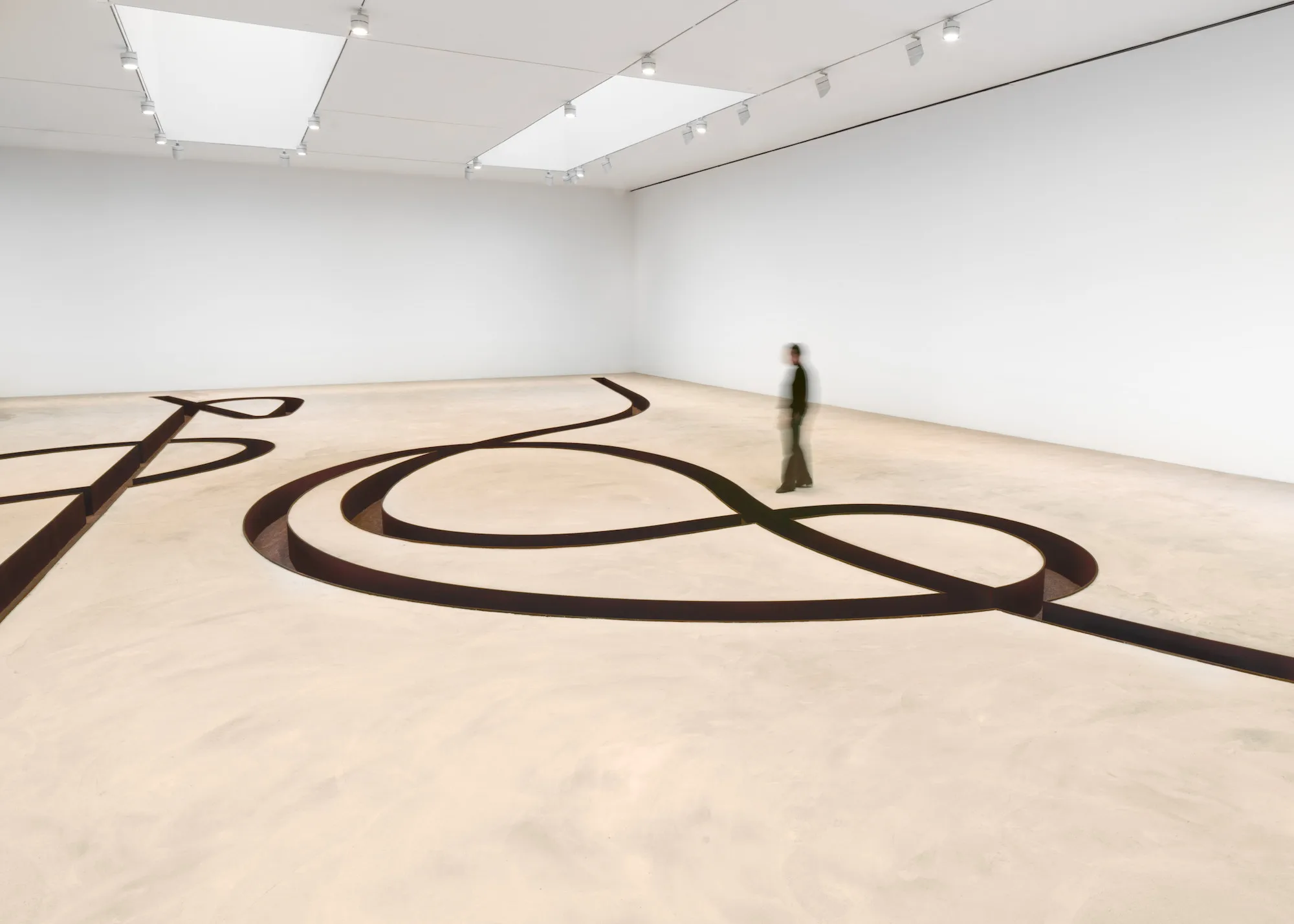
This thinking appears in a concentrated form in Convoluted Line A and Convoluted Line B (2024), developed for the gallery space in New York. The two works traverse the concrete floor as continuous lines, inserted into the surface. At first glance, they can be read as a drawing. As one approaches, they reveal their physical dimension and the scale of the gesture.
What is at stake is not just the form, but the way the space organizes itself around it. The lines do not guide the gaze in a frontal manner. They demand displacement. The visitor follows the path over time, walking along the work, adjusting their own rhythm to the extension of the pieces.
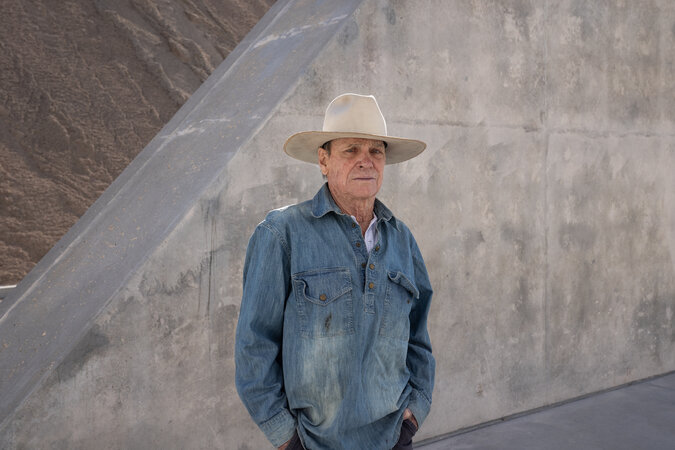
This type of relationship was already present in works such as Double Negative, carried out in Nevada, where two large excavations on opposite sides of a canyon establish a field of tension that can only be understood through direct experience on site.
In the current exhibition, this logic is brought inside the Gagosian without losing its physical dimension. The exhibition space ceases to function merely as a support and is instead activated by the interventions. The works do not enclose themselves. They depend on the presence, time, and movement of those who traverse the environment.
Throughout the exhibition, drawings produced in the 1960s and 1970s also help to situate this trajectory. They already reveal an interest in the line as a structure and in the relationship between full and empty space, which later expands into the three-dimensional field.
In Negative Sculpture, Michael Heizer does not present a rupture, but a consistent unfolding of his practice. The scale changes, the context changes, but the central question remains: how to transform space into a matter of work and the body into a measure of experience.
Complete TV · Reels
STELLAR IRIS, by artist Thomas Blanchard
See on InstagramFrom Complete




More from Caíque Nucci
View profile
Latest from Complete
 FashionFORCA Studio at SPFW N61: Forca X, Bridgestone tire and punk leather
 DesignTomie Ohtake House‑Studio presents Zanine Caldas
 The CoverIn the beginning, we couldn't even use the word handicraft.
 CultureThievery Corporation, 30 years: the Washington duo that originated in bossa nova
 InnovationLight has become a building material
 The CoverBrazil still gives little recognition to genuinely Brazilian authorial fashion.
 BeautyBORNTOSTANDOUT arrives in Brazil