

The Invisible Networks Shaping Global Luxury
In an industry characterized by rapid changes, strategic successions and battles for cultural relevance, fashion is undergoing a period of reorganization.
Words by

Words by Sarah Rocksane Araujo
Editorial, Fashion and Beauty
The constant turnover of creative directors among major fashion houses, once seen only as corporate maneuvering, has begun to reveal something deeper: a network of influence, intellectual formation, and creative continuity that links decades of cultural production. It is precisely in this territory that the Creative Directory emerges, a project developed by researcher and journalist Ashantéa Austin.
More than an organogram, the material produced by Austin functions as a cartography of the industry's genealogies. The flowchart connects founders, designers, successors and collaborations among historic houses such as Chanel, Dior, Balenciaga, Maison Margiela, Gucci, Louis Vuitton, Prada and countless others, highlighting how fashion is built less by absolute ruptures and more by shifts in language.
Authorship in fashion is never wholly individual; it is inherited, reinterpreted, tensioned and redistributed in continuous cycles. The central image of the project impresses not only through the amount of information but also through its very visual architecture. The flowchart reveals something that often goes unnoticed in the rapid consumption of trends: creators move between houses carrying aesthetic codes, construction methods, cultural references and even specific ways of thinking about the body. When Phoebe Philo leaves Céline and influences an entire generation of contemporary minimalism, or when Martin Margiela transforms the deconstructive thinking of European tailoring, these reverberations do not end at the close of a contract. They continue to permeate teams, disciples, collaborators and successors. Austin’s project gains even more relevance at a time of extreme creative volatility. In recent years, the market has witnessed successive changes at brands such as Gucci, Bottega Veneta, Chanel, Helmut Lang and Maison Margiela, where creative directors have become almost nomadic figures, moving swiftly between luxury conglomerates; in this context, tracking the trajectory of ideas has become as important as tracking the garments themselves. There is also an important political dimension to this type of research.
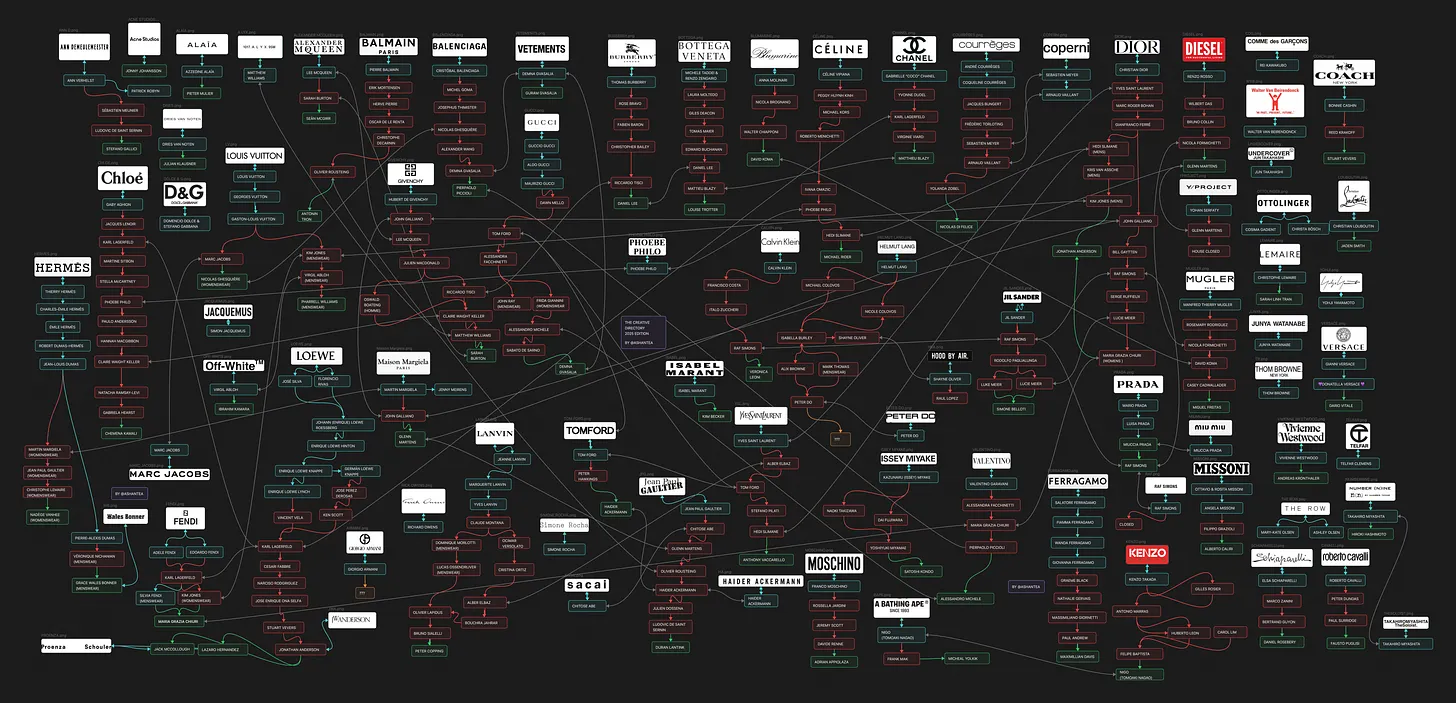
By stating that “this information did not exist holistically anywhere,” Ashantéa Austin points to a central issue in contemporary fashion: knowledge is still often treated as a restricted capital. Fashion history remains fragmented among closed archives, academic publications, and scattered information in interviews, documentaries, and old magazines. For a long time, fashion education privileged linear narratives, organized by decades or dominant styles. The flowchart proposes another reading: a connective and relational history. Instead of seeing brands as isolated entities, the project shows the industry as a large interdependent network.
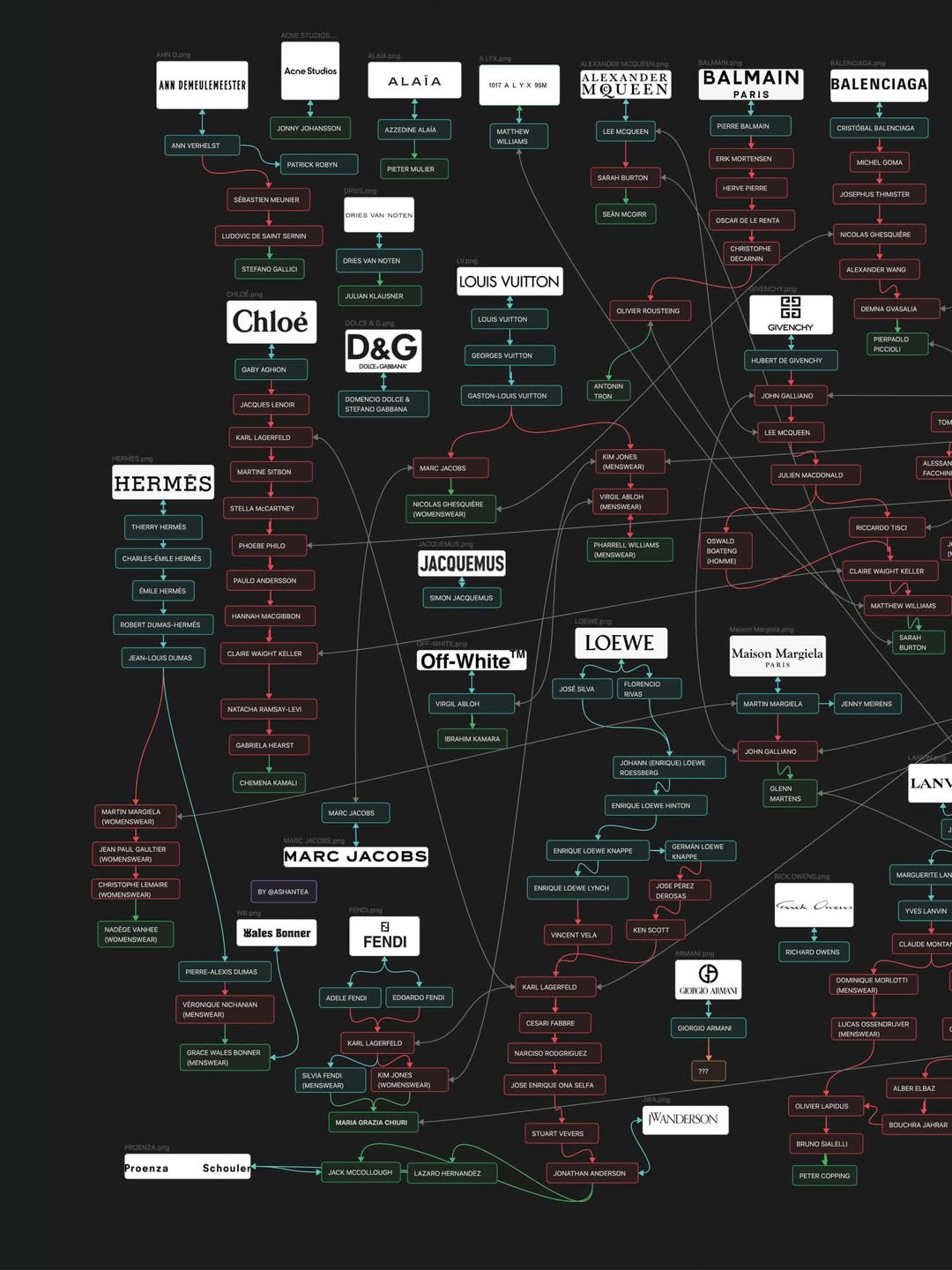
Another evident aspect in the flowchart is the transformation of the creative director's role over the decades. While the designer was previously associated mainly with clothing creation, today they occupy a much broader function, involving branding, digital storytelling, cultural positioning and the construction of global desire. The contemporary creative director must simultaneously manage runway, imagery, social media, point of sale, collaborations, campaigns and financial impact. This shift helps explain the speed of recent replacements. The industry has come to demand almost immediate results on a global scale.
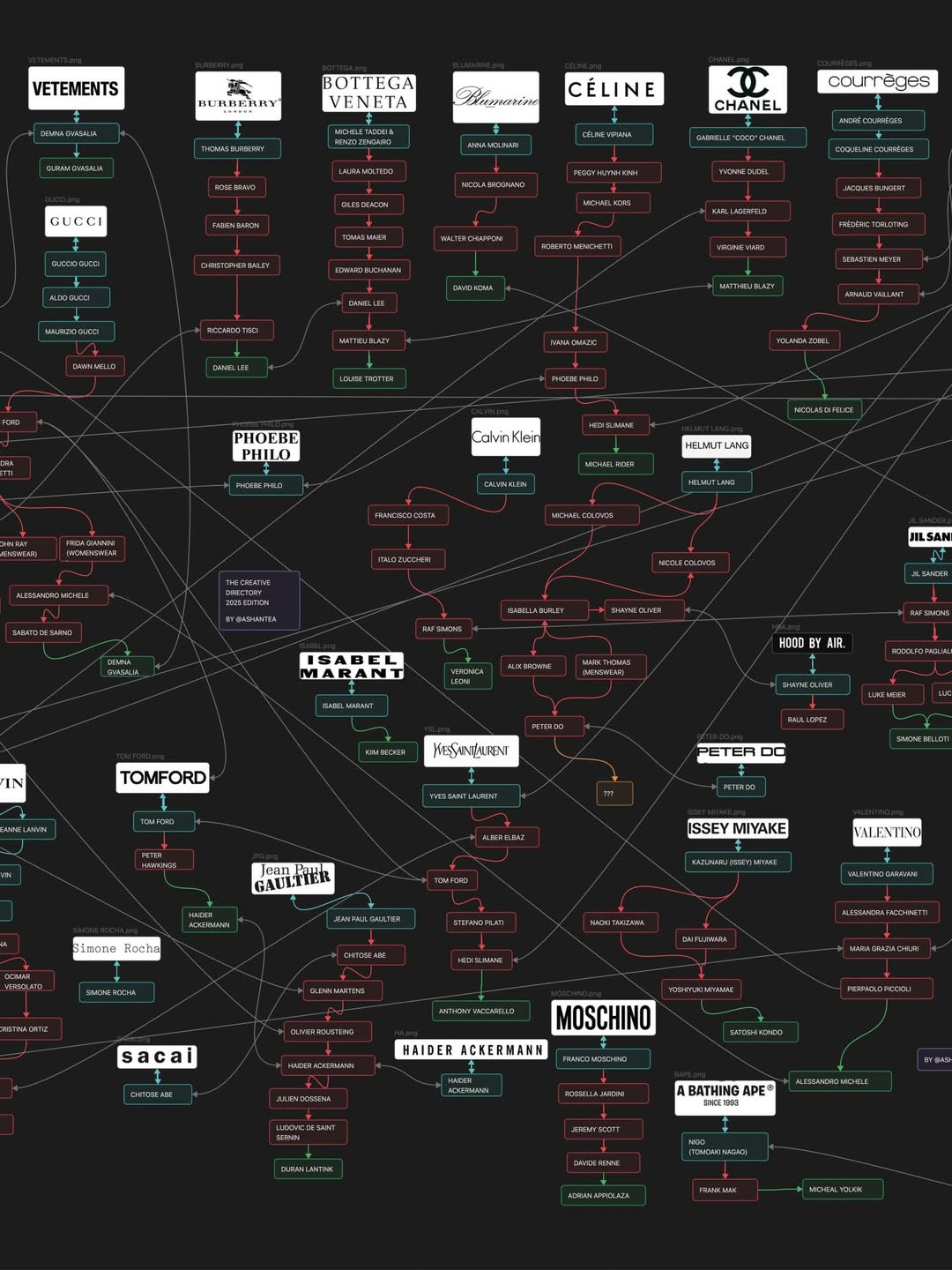
In many cases, collections are judged not only on aesthetic innovation but also on immediate commercial performance and algorithmic impact. There is also a silent emotional dimension present in the map. Connecting names reveals that fashion is built on complex human relationships, creative alliances, mentorships and affective continuities. Many designers began as assistants, apprentices or collaborators before taking on major maisons. The transfer of knowledge in fashion often occurs in an almost artisanal way, within ateliers, through intense cohabitation relationships.
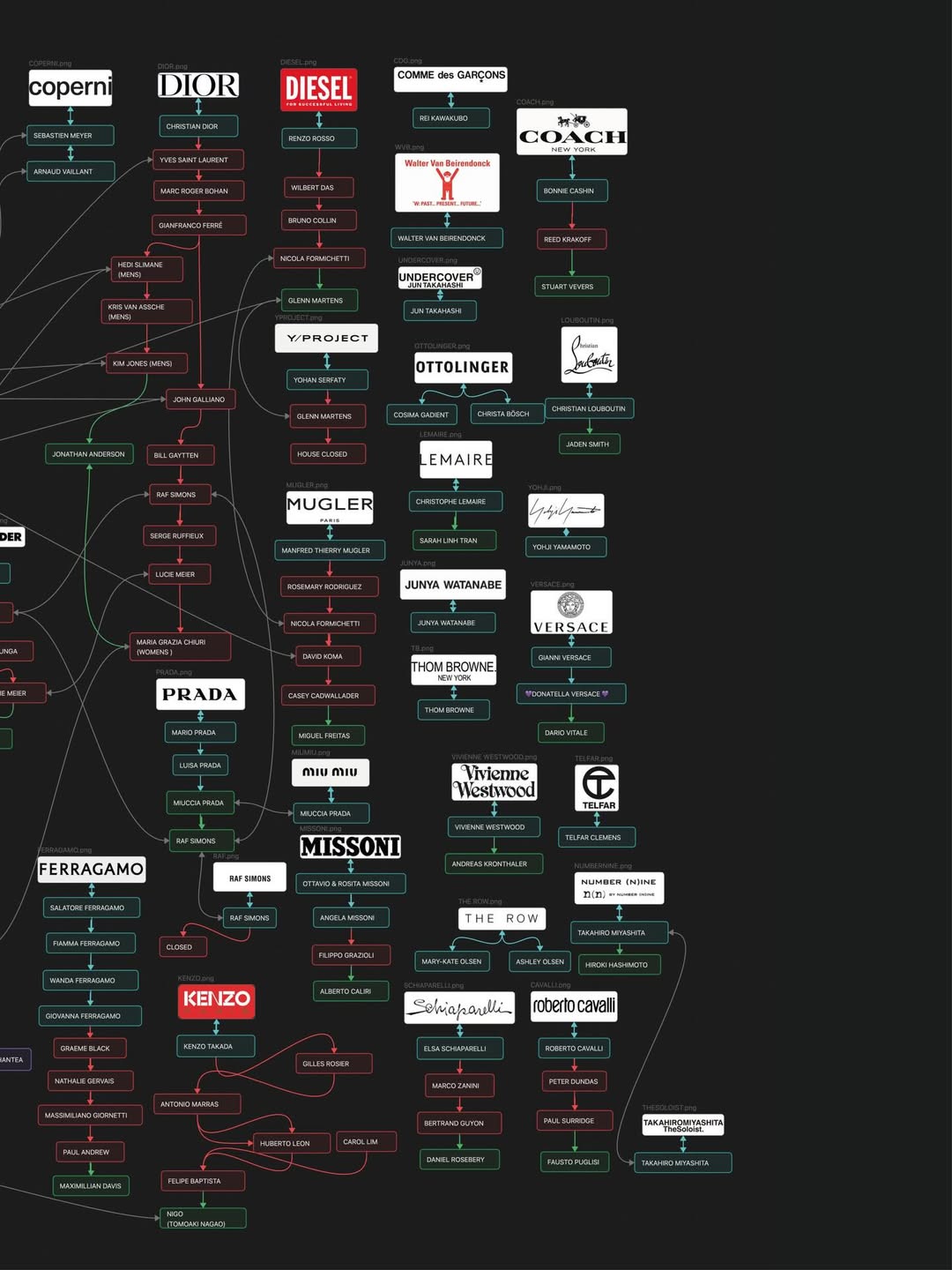
When Austin mentions the desire to eventually include schools, internships and formative pathways, she further expands the research's potential. Knowing that Martin Margiela and Glenn Martens were influenced by Jean Paul Gaultier, for example, helps understand not only formal choices but entire genealogies of aesthetic thought. Fashion ceases to be merely image and becomes also an intellectual transmission. For decades, the industry was organized around a few hegemonic capitals and relatively stable Eurocentric narratives. Today, however, the system is undergoing reorganization. Georgian, Japanese, Belgian, African and Latin American designers have begun to contest symbolic space within the major global structures. This shift appears visually in the cross‑connections between brands traditionally associated with different cultural codes. Contemporary luxury no longer operates solely through the preservation of tradition, but through the capacity to absorb subcultures, urban tensions, digital references and political discourse.
The logic of organization and representation in the organogram explains why certain creative changes seem to occur almost in chain reactions. When a designer leaves a brand, other movements immediately reorganize in response. Austin's map makes visible this domino effect that usually remains invisible to the general public. The Creative Directory also shows how fashion is experiencing a moment comparable to the period between 2003 and 2008, as the author herself suggests. At that time, the rise of figures such as Hedi Slimane, Phoebe Philo, Nicolas Ghesquière and Alexander McQueen radically redefined the visual codes of luxury. Today, a similar reorganization appears to be taking place, driven by technological transformations, generational shifts and global economic crises. The speed of this transition creates an interesting paradox. Never has there been so much information about fashion circulating digitally, yet it has never been so difficult to understand the industry structurally. The excess of fragmented content produces historical disorientation. The flowchart emerges precisely as an attempt to reorganize contemporary chaos into a readable narrative.
But perhaps the most important aspect of the project is the understanding that fashion is not merely clothing. Fashion is cultural transmission, economic structure, visual pedagogy and collective memory. Each shift in creative direction represents a narrative change about body, desire, consumption and identity. By turning these relationships into image, Ashantéa Austin creates something rare: an instrument capable of making visible the invisible infrastructure of contemporary creativity. Its flowchart shows that fashion history does not progress in a straight line. It moves in a spiral, through reunions, reinterpretations and continuous displacements.
At a time when the industry often seems caught between nostalgia and digital acceleration, the Creative Directory offers an essential historical perspective. It reminds that every innovation arises from prior connections, shared influences and complex human networks. No creator emerges in isolation.
Complete TV · Reels
THE IMAGE THAT RESPONDS TO HANDS, by Anton Berkasov
See on InstagramFrom Complete





More from Sarah Rocksane Araujo
View profile


Latest from Complete
 CultureMaja Petrić: the artist who wrote her own artificial intelligence
 InnovationLight has become a building material
 The CoverBrazil still gives little recognition to genuinely Brazilian authorial fashion.
 FashionFashion and the addiction of evaporation
 DesignAnton Berkasov plays his own art as one would play an instrument
 The Cover"I'm more afraid of being bored than of trying something new"
 BeautyBORNTOSTANDOUT arrives in Brazil