
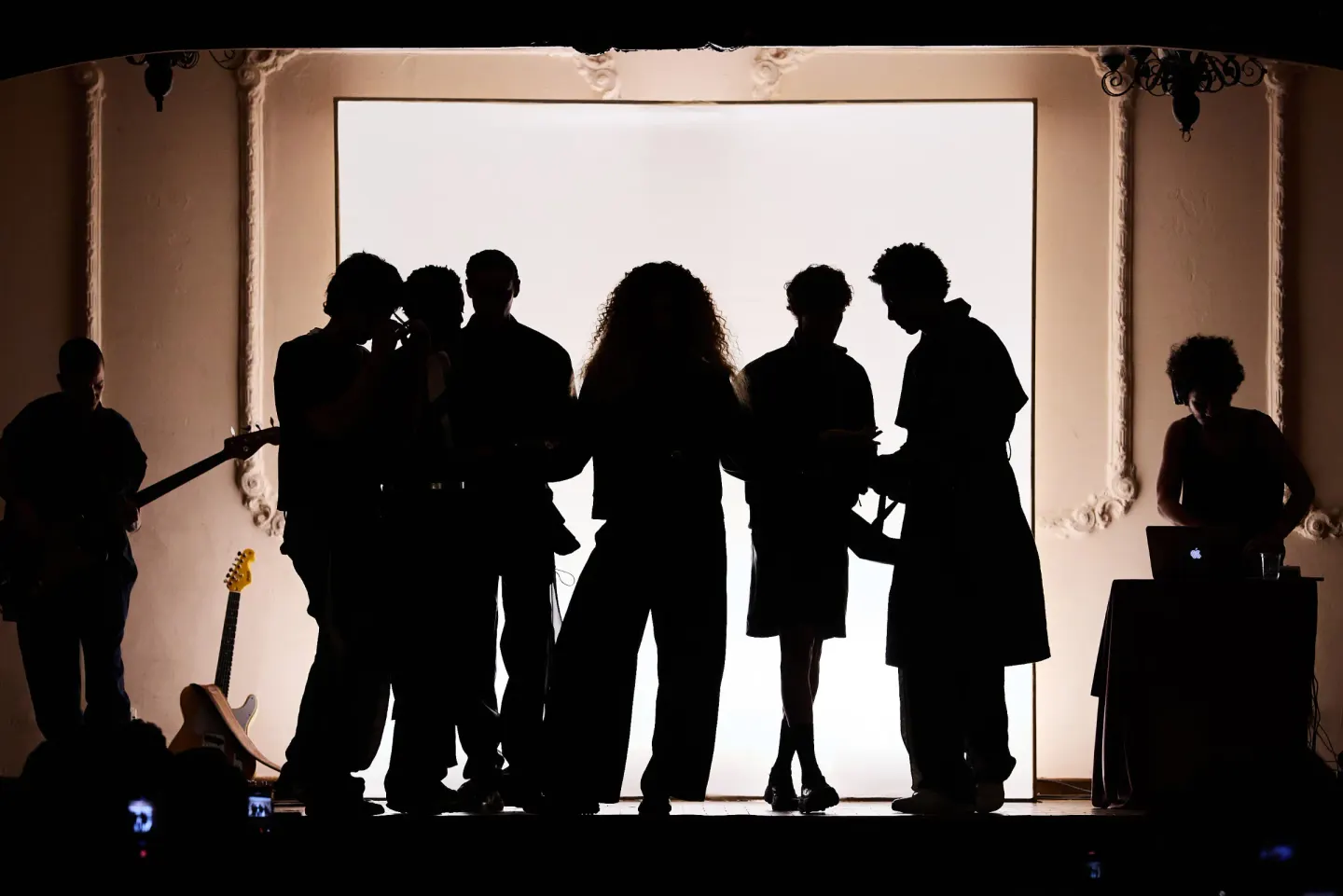
Luiz Claudio Silva and Carlos Penna present the stage
There are encounters that begin at work, yet in the desire to try something new they find the possibility of creating their own language.
Words by
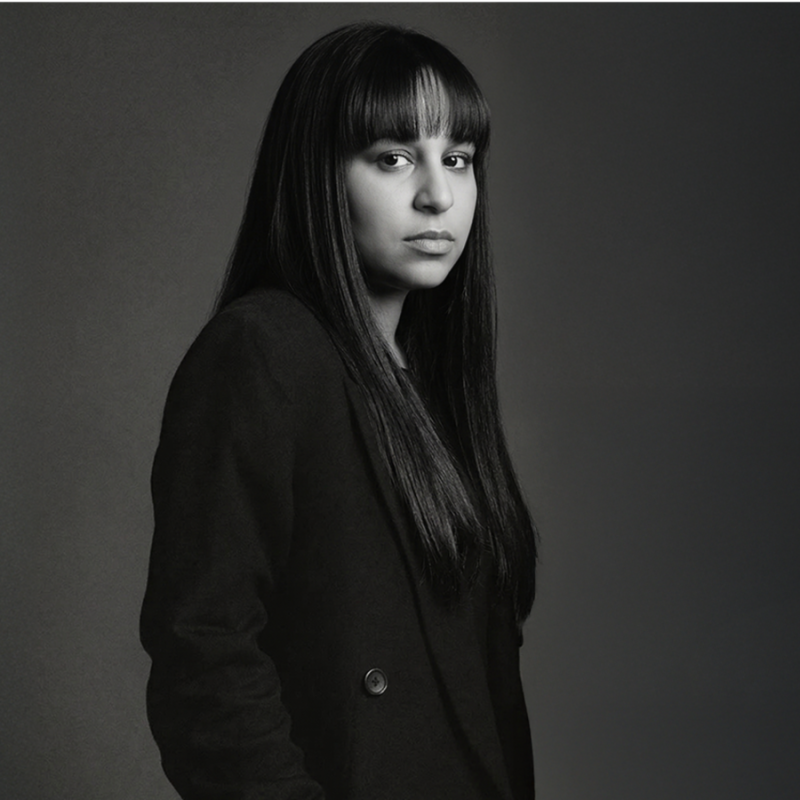
Words by Sarah Rocksane Araujo
Editorial, Fashion and Beauty · October 12, 2026
The connection between Luiz Claudio Silva and Carlos Penna originated precisely in that setting, when the designer was invited to develop the accessories for Apartamento 03’s runway shows, a brand led by Luiz. What began as a professional collaboration quickly turned into friendship, aesthetic affinity, and a desire to create together. Over the course of the process, the two recognized that their experiences, though distinct, could find a point of convergence capable of raising new questions about fashion.
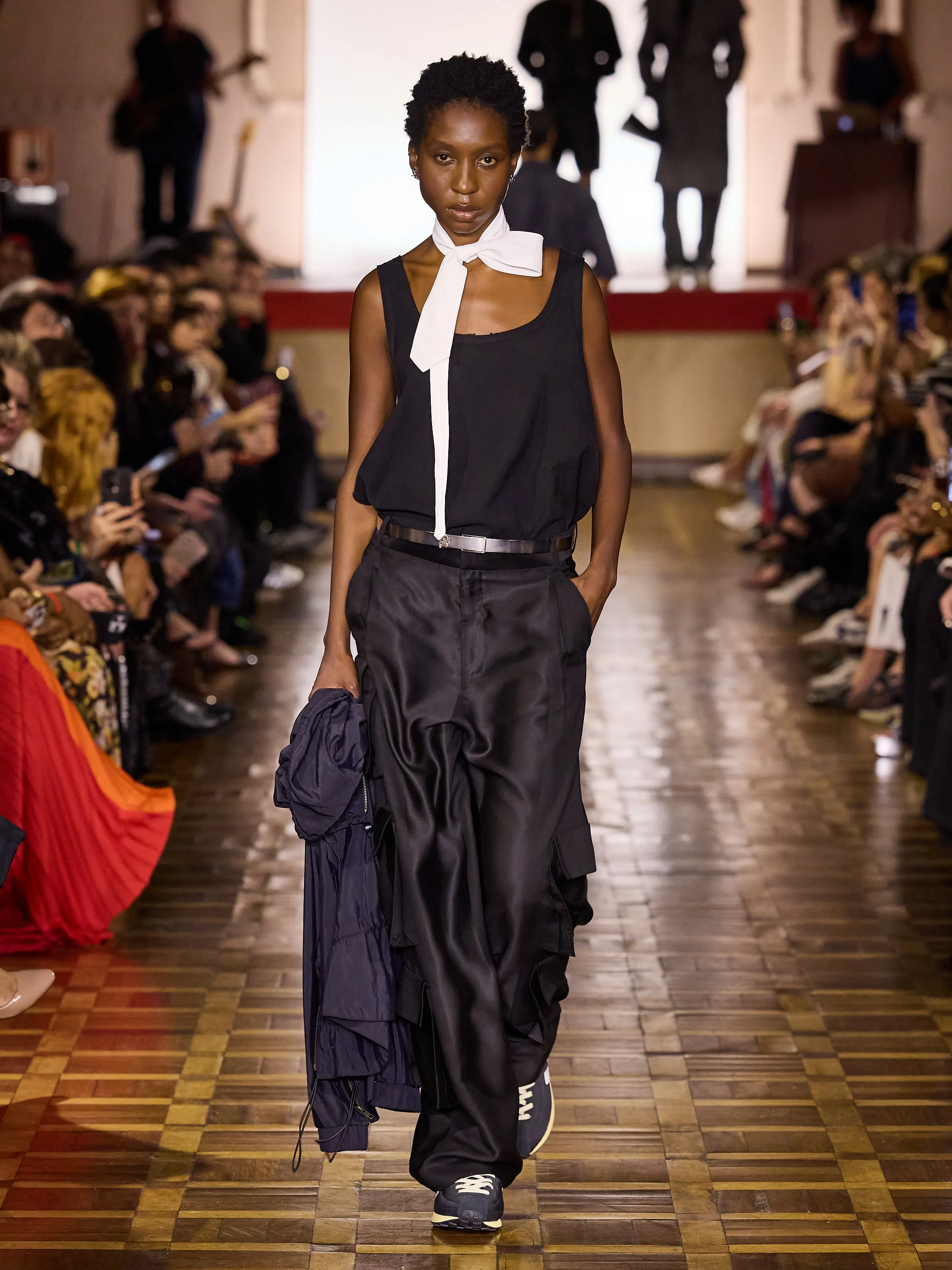
At the beginning of 2025, the idea of developing a brand from scratch began to take on more defined contours, fueled by the perception that there is still space for other narratives within a segment historically associated with rigid dress codes, predictable silhouettes and gender conventions. More than adding repertoires, the duo decided to investigate what could emerge when the precision of tailoring met the freedom of accessories, when structure conversed with movement, and when dressing ceased to respond only to established expectations to become an open field of experimentation.
The result of this collaboration was presented on Wednesday, September 30, in a runway‑performance held at União Fraterna in São Paulo. The debut was not limited to showcasing a collection; it offered a staged experience in which clothing, body, and performance contributed to a unified narrative. After all, when two creators choose to share not only a label but also a concern, the birth of a brand can signify something larger: the chance to push the boundaries of an already familiar imagination.
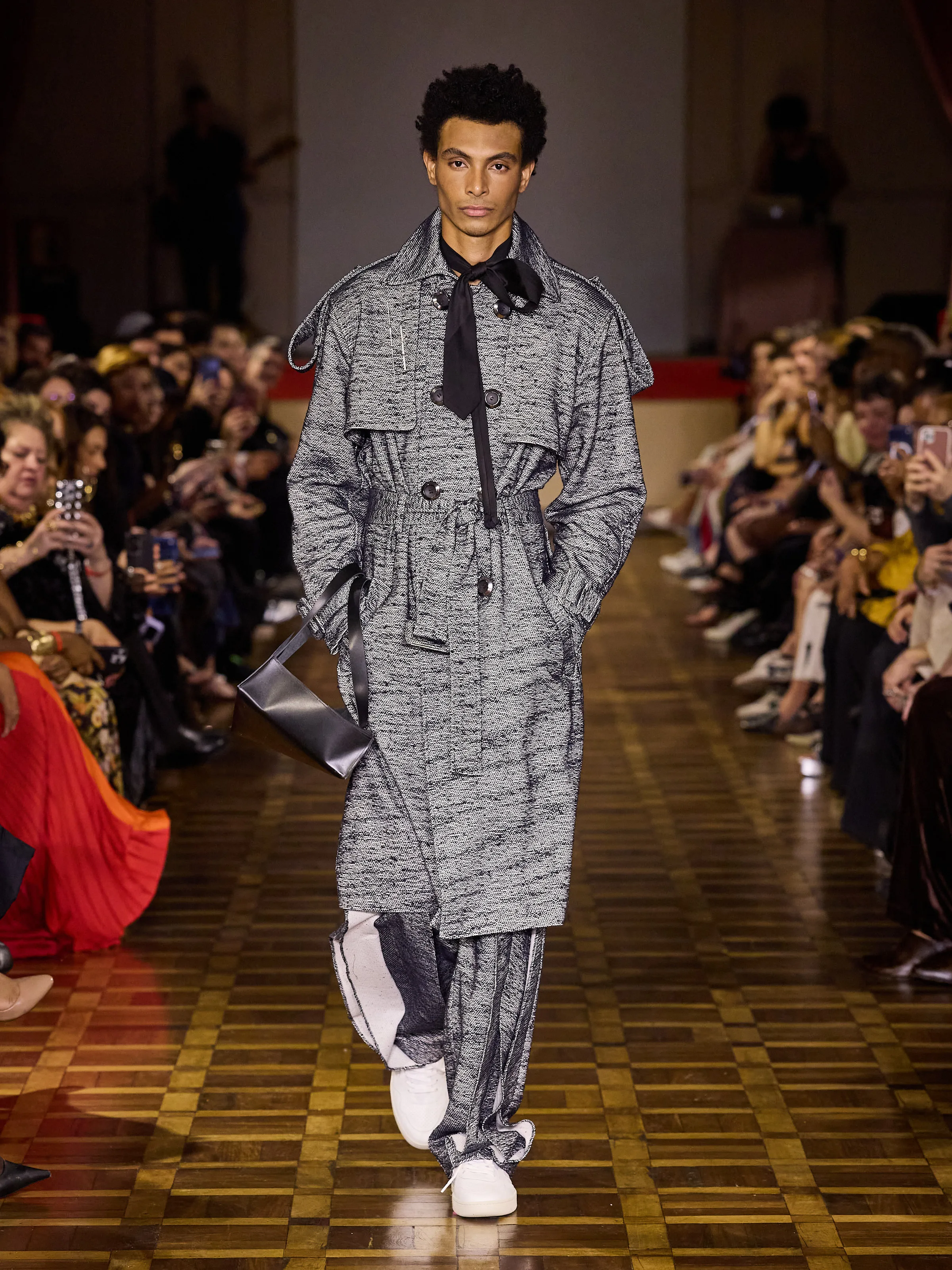
For a long time, a significant portion of the male repertoire has been organized around restraint, functionality and the repetition of codes that link elegance to discretion and maturity to the absence of excess. Even as contemporary fashion expands its possibilities, certain limits continue to shape how bodies are dressed, perceived and permitted to occupy spaces. It is in this territory that the partnership finds its potency: not necessarily in a wholesale rejection of tradition, but in the possibility of revisiting its elements, displacing them and uncovering new relationships among form, material and identity.
Tailoring, for example, remains the foundation of the collection, but it no longer functions solely as a symbol of formality. The broad constructions, generous volumes and ornamental details open space for a less disciplined reading of clothing, in which structure does not have to signify rigidity and elegance does not depend on obedience to a single silhouette. In this movement there is an understanding of fashion as cultural language: dressing is also negotiating conventions, crafting presences and experimenting with ways of existing. By recognizing the insufficiency of certain formulas, Luiz and Carlos do not simply aim to fill a market category. The intention appears to be to expand the available vocabulary, creating pieces that preserve the familiarity of classic elements while altering their intonation. The result is an investigation of possible masculinities, in which the design of clothing ceases to be merely a question of proportion and becomes part of a broader conversation about aesthetic freedom, individual expression and the transformation of the codes that define dressing.
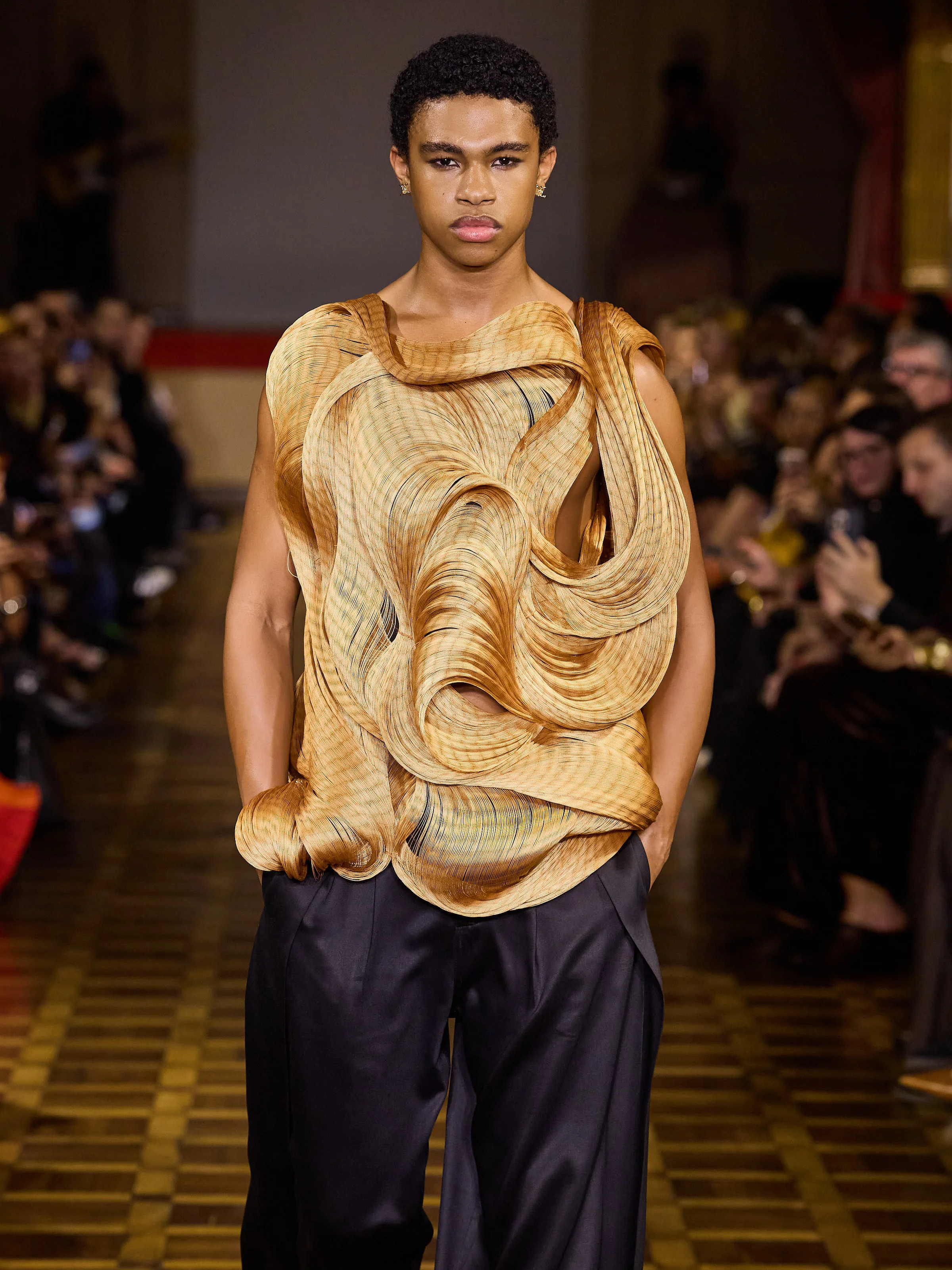
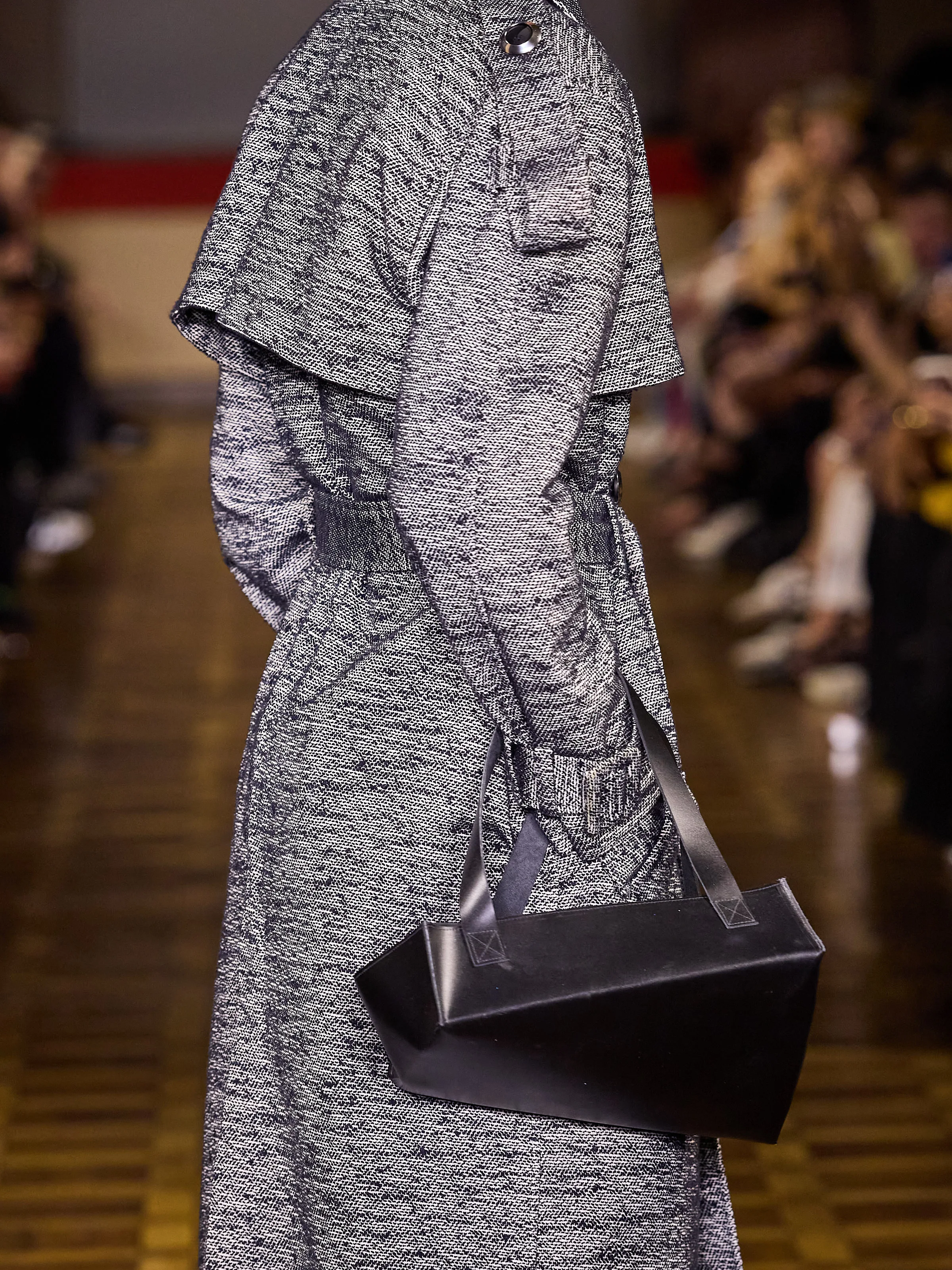
Tailoring forms the backbone of this debut collection, supported by the experience Luiz has amassed over two decades leading Apartamento 03. Pants, blazers and trench coats appear in expansive constructions, with volumes that move away from the conventional waistline marking and favor a freer relationship between body and fabric. The squared silhouettes do not necessarily aim to delineate anatomy, but to create a wearable architecture in which the space between garment and body also contributes to the composition. Ruffles introduce movement and soften the geometry of certain pieces, while satin adds luminosity and alters how surfaces respond to light. Crochet, in turn, establishes another material temporality, bringing the tailoring repertoire closer to a construction that carries texture, handcraft and delicacy.
It is precisely in the meeting of these different materialities that the collection reveals one of its most interesting questions: the possibility of making codes coexist that, in a more conventional reading, might seem disparate. The precision of the cut does not eliminate fluidity; the structure does not impede ornamentation; the finish does not need to erase the garment’s sensory dimension. The accessories developed by Carlos Penna occupy a decisive place in this equation. A specialist in silver details, the designer incorporates tie clips and brooches that shift objects traditionally associated with masculine formality into the realm of authorial composition.
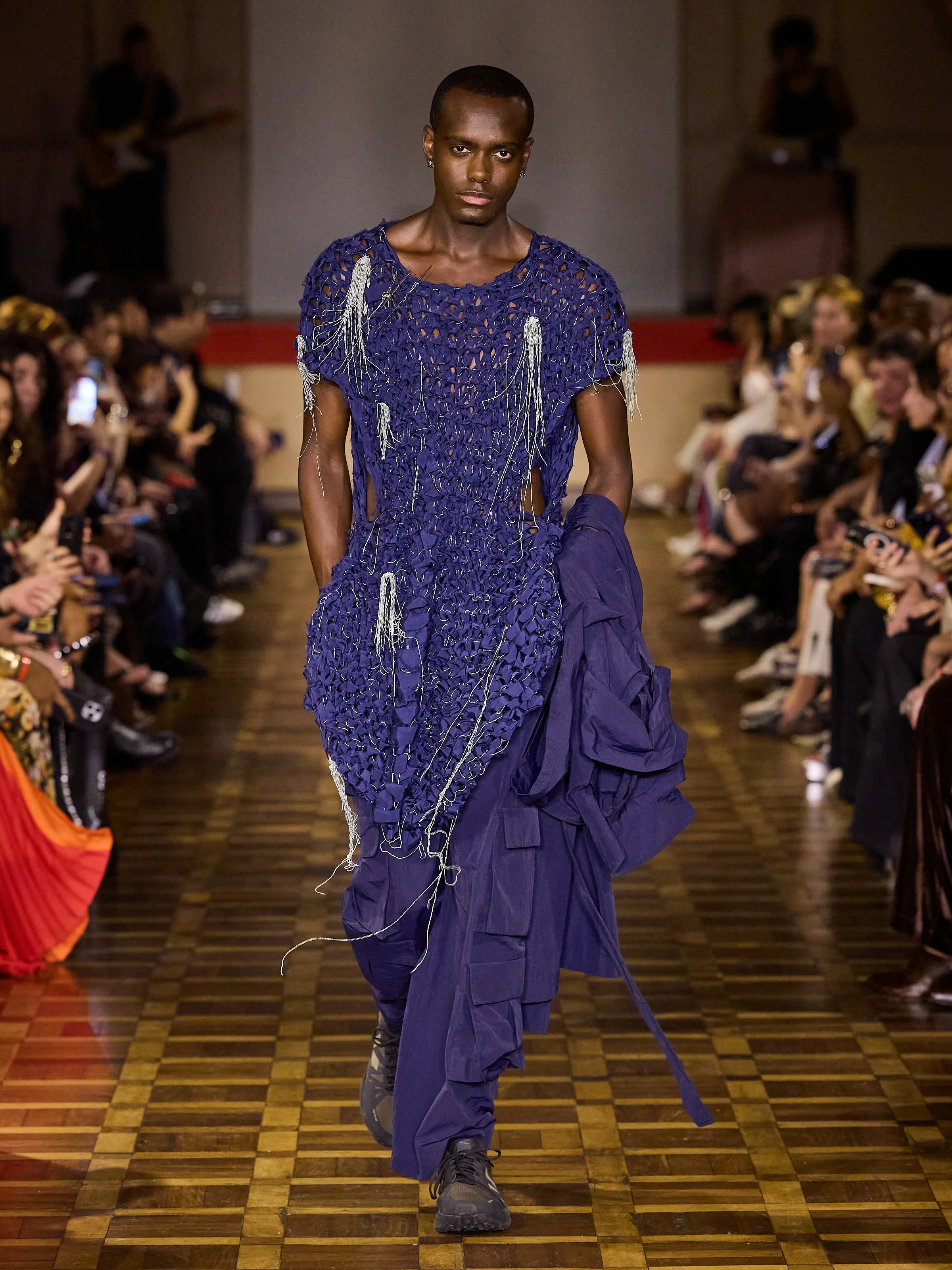
Instead of functioning as discreet complements, these pieces actively participate in constructing the looks, introducing focal points and new combination possibilities. Silver, with its cold shine, establishes a particular dialogue with the fabrics, creating contrasts between opaque and reflective surfaces. More than ornamentation, accessories interfere with the reading of the garment, showing how small elements can reorganize an entire silhouette. In this collection, detail does not appear as a secondary finish but as part of a language that understands dressing in layers, relationships and displacements. Tailoring provides the structure; the materials generate tension; the accessories introduce new inflections. Together, these elements build a visual narrative that does not rely on a single gesture to assert its identity.
Among the elements that draw the most attention are the leather pieces, the top made with rings, and the shorts with side openings. These proposals introduce a particular sensuality to the collection, less interested in offering an isolated provocation than in expanding the possibilities of exposure and body construction. Leather adds density and presence, while the rings turn a metallic element into a wearable structure, bringing the accessory closer to the garment’s own architecture. The side openings of the shorts alter the relationship between coverage and revelation, introducing movement and suggesting that sensuality can also arise from cut, space, and the way the body reveals itself during movement. These details are important because they help understand the collection beyond a simple update of tailoring. There is research on how materials can produce different sensations and how clothing can suggest other relationships with the skin, without abandoning formal elaboration.
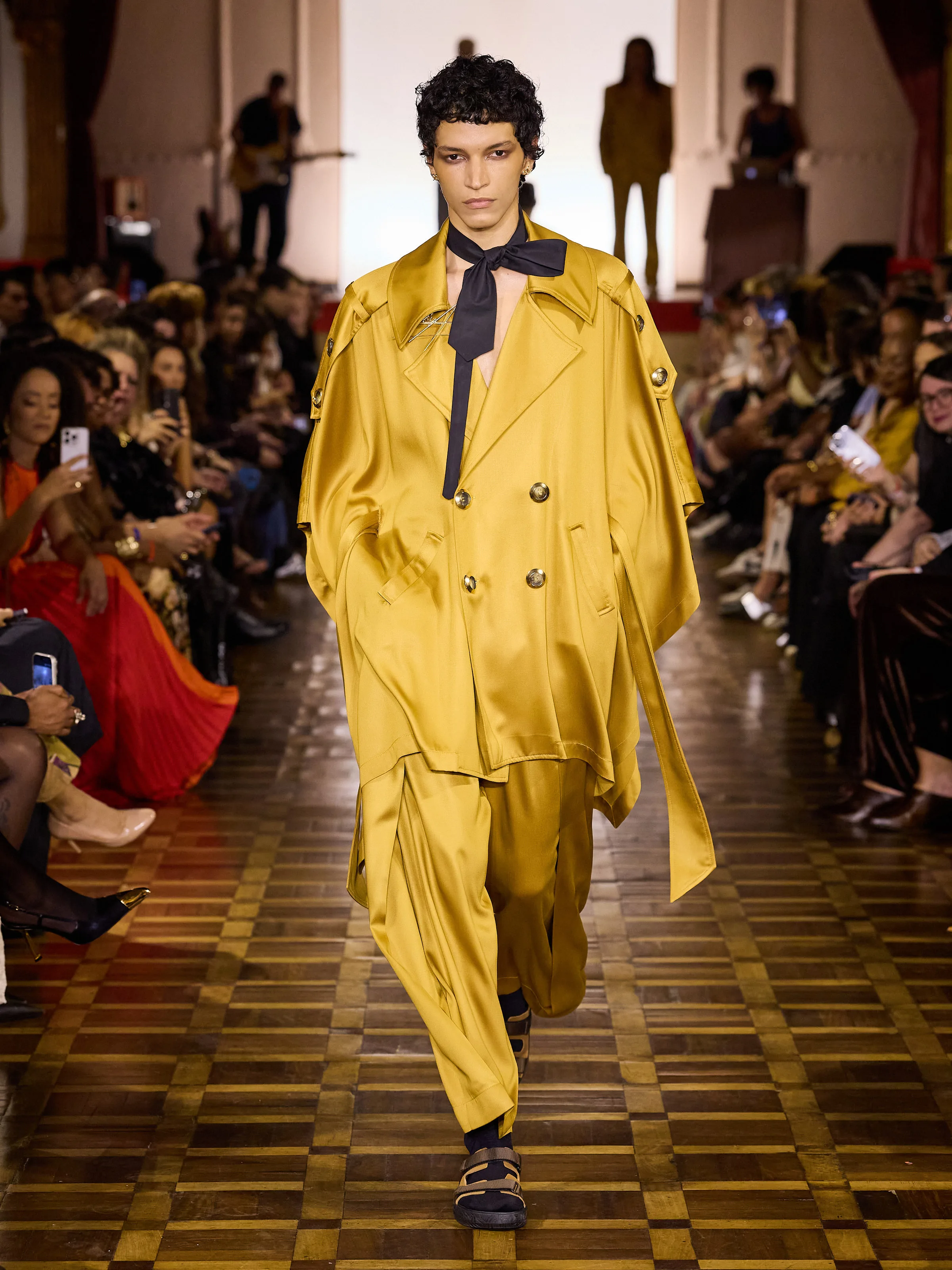
Sensuality, in this context, should not be confused with excess or exhibitionism. It can reside in the construction of an opening, the texture of a fabric, the sheen of a surface, or the way a garment follows the movements of its wearer. At the same time, the presence of these elements reveals a willingness to question the boundary between what is typically classified as masculine and what, by convention, has been associated with femininity.
The collection seems to operate precisely in that interval, acknowledging the strength of tailoring without treating it as a closed system and incorporating ornament without reducing it to a decorative device. Silver can be as structural as the cut; crochet can converse with the precision of the blazer; leather can introduce sensuality without nullifying the sobriety of the composition. The power lies in the relationship between these elements, in how each choice alters the perception of the others. For fashion that seeks renewal, it may be necessary to look less at the obligation to produce something entirely new and more at the ability to reorganize what already exists, identifying other possibilities in known materials, techniques and gestures. The encounter between Luiz and Carlos suggests that creation is also built through approximations: two trajectories that recognize each other, two specialties that complement each other and a project that begins to find its own voice.
Complete TV · Reels
A geografia sonora do Atlântico virou imagem e espaço.
See on InstagramFrom Complete



More from Sarah Rocksane Araujo
View profile

Latest from Complete
 FashionFabiana Milazzo presents Passarim
 CultureThievery Corporation, 30 years: the Washington duo that originated in bossa nova
 The CoverBrazil still gives little recognition to genuinely Brazilian authorial fashion.
 InnovationLight has become a building material
 DesignAnton Berkasov plays his own art as one would play an instrument
 The Cover"I'm more afraid of being bored than of trying something new"
 BeautyBORNTOSTANDOUT arrives in Brazil