

Why do designers wear black?
From the first cave marks made with charcoal to the dramatic shadows of the Renaissance, black has always served as the ground for the sacred, the hidden, the sophisticated and the political.
Words by

Words by Gilles Pedroza Leite
Design and Innovation
Listen to this story
Black is not a primary, secondary or tertiary colour. Nor is it on the colour wheel. Black is, in fact, the absorption of every colour, a vortex of swallowed light. Invisible on the conventional palette, but everywhere on the surfaces of design, black is an absence that means far too much. And perhaps for that reason it is one of the most powerful presences in the history of art, fashion and visual culture.
From the first cave marks made with charcoal to the dramatic shadows of the Renaissance, black has always served as the ground for the sacred, the hidden, the sophisticated and the political. In Ancient Egypt it stood for fertility. In the European Middle Ages, for power and wealth. For the modern world, it is the colour of quiet elegance and of quiet rebellion too. But there is nothing quiet in the way black communicates. It carries many layers of meaning and contradiction. For some it is mourning; for others, authority. It is the colour of uniforms, of protests, of luxury and of subversion. Black is always loaded, never neutral, though designers frequently use it as if it were. It is curious how black, worn on the body, becomes a tool of invisibility.

Why do so many designers wear black? The most pragmatic answer is focus: when you work with an explosion of colour in the project, black in the wardrobe calms and neutralises. It is the uniform of those who prefer attention to be on the work and not on the designer. Black helps the work stand out, not the person who makes it. But there is something deeper in that gesture. Black is also an aesthetic and political choice. It is the refusal of excess, of noise, of distraction.
It is the colour that stands for the silence of the ego before the creative process. Designers such as Jonathan Anderson, Gustavo Piqueira, Giorgia Lupi and Paula Scher, for instance, dress with an almost comic simplicity against the theatricality of their creations. A clear separation between author and work. Even so, we need to look carefully at the cultural weight black carries. In many languages and expressions such as blacklist, black sheep, “black market”, black is portrayed as tied to negativity, danger or exclusion. Those connotations, often racialised, are not mere coincidence. Design, as a field of language and representation, must question those structures.

Perhaps black was never “just a colour”. It is a reflective surface, symbolic, historical and cultural. A dark mirror onto which we project our fears, desires and values. And in that sense it remains one of the most powerful tools in the human visual repertoire. Black goes with everything. But, more than that: black says everything.
Complete TV · Reels
@egon_lab Lazarus.
See on InstagramFrom Complete




More from Gilles Pedroza Leite
View profile


Latest from Complete
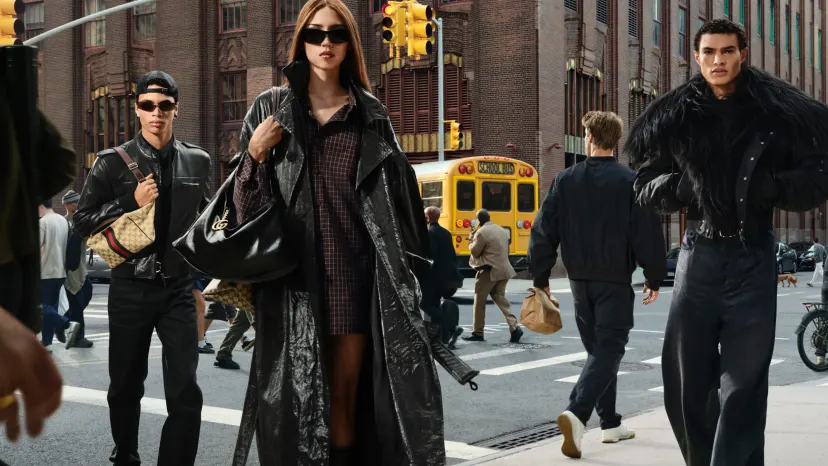 FashionGuccicore: plurality as a language of style
 BeautyISDIN Fusion Water Magic: sun protection with lightness and technology
 The CoverIn the beginning, we couldn't even use the word handicraft.
 DesignTomie Ohtake House‑Studio presents Zanine Caldas
 CultureThievery Corporation, 30 years: the Washington duo that originated in bossa nova
 The CoverBrazil still gives little recognition to genuinely Brazilian authorial fashion.
 InnovationLight has become a building material