

Richard Wilson: architecture and sculpture between matter and illusion
With a career spanning more than three decades, Wilson has established himself internationally through large-scale architectural interventions that turn everyday spaces into complex sensory experiences.
Words by

Words by Gilles Pedroza Leite
Design and Innovation
Listen to this story
Richard Wilson, born in 1953, is one of the most prominent contemporary British sculptors. With a career spanning more than three decades, Wilson has established himself internationally through large-scale architectural interventions that turn everyday spaces into complex sensory experiences. Drawing on the worlds of engineering and construction, his work reconfigures architecture as a field of perceptual instability, where form, structure and function are questioned in favour of surprise, disorientation and estrangement.
His projects are known for subverting the traditional understanding of sculpture as an autonomous object. Instead, Wilson works on built space, modifying its physical and symbolic properties. Works such as 20:50, a permanent installation in the Saatchi Collection made of a sea of sump oil that mirrors the room, exemplify his commitment to provoking the eye and radically altering the visitor's perception. In that case, the raw material is not only the dark oil, but emptiness itself, the reflection and the body of the viewer, who finds themselves immersed in an inverted and silent architecture.
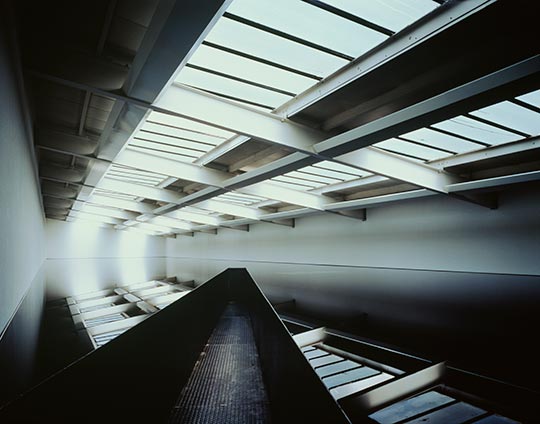
Twice nominated for the Turner Prize, Wilson also received the prestigious DAAD residency in Berlin (1992 to 93), was elected a member of the Royal Academy of Arts in 2006, and named honorary professor of sculpture at the Royal Academy Schools. His path combines institutional recognition and public impact, present not only in galleries but also in urban interventions that reconfigure the collective experience of the city.
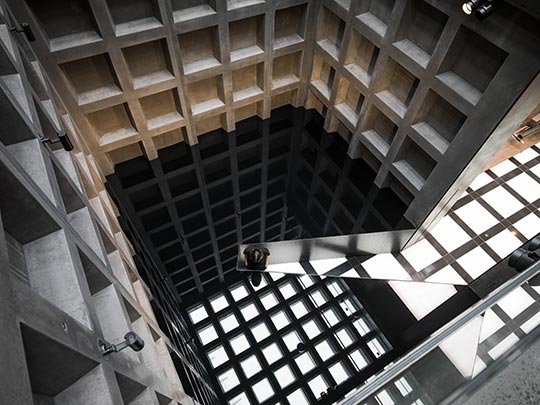
More than setting or support, built space becomes expressive material, subject to manipulation, questioning and invention. By intervening in walls, ceilings, stairs and structures with cuts, displacements and rotating mechanisms, the artist puts the limits between art, engineering and perception under tension, activating architecture as a sensitive and unstable body. His projects deconstruct the idea that space is something fixed, functional or predictable. Each intervention challenges structural logic to reveal new possible narratives, spaces that fold, turn or reflect, demanding of the viewer a renewed attention to their surroundings. Architecture, in that context, stops being neutral: it becomes a dynamic organism, charged with ambiguity, where the sculptural gesture opens zones of doubt, suspension and wonder. For Wilson, sculpture is less an object than an operation on space, a device for reimagining its uses, meanings and limits.
Complete TV · Reels
STELLAR IRIS, do artista Thomas Blanchard
See on InstagramFrom Complete



More from Gilles Pedroza Leite
View profile


Latest from Complete
 FashionFORCA Studio at SPFW N61: Forca X, Bridgestone tire and punk leather
 DesignTomie Ohtake House‑Studio presents Zanine Caldas
 The CoverIn the beginning, we couldn't even use the word handicraft.
 CultureThievery Corporation, 30 years: the Washington duo that originated in bossa nova
 InnovationLight has become a building material
 The CoverBrazil still gives little recognition to genuinely Brazilian authorial fashion.
 BeautyBORNTOSTANDOUT arrives in Brazil