

Who legitimizes contemporary art?
Contemporary art has built for itself a seductive narrative. It presents itself as a territory of freedom, experimentation, and social critique. It defines itself as a space of dissent, diversity, and cultural transformation.
Words by
Words by Sarah Rocksane Araujo
Editorial, Fashion and Beauty
However, when we closely examine its mechanisms of operation, a difficult-to-ignore contradiction emerges: while the discourse celebrates openness and innovation, the structure often operates through closed circuits of legitimacy, access, and recognition. What should function as an ecosystem for the circulation of ideas often approaches a reciprocal validation architecture, in which the same agents, institutions, and narratives continuously
Contemporary art has become one of the most sophisticated fields of symbolic production worldwide, yet also one of the most complex systems for maintaining cultural power. The notion of ecosystem, widely employed by museums, galleries, fairs and cultural institutions, suggests diversity, interdependence and constant renewal. In practice, however, the international art circuit often operates as a concentrated network of influence. Curators circulate among the same biennials, gallerists attend the same events, collectors move within the same social circles, and artists vie for visibility within a relatively limited set of opportunities. The result is not necessarily deliberate exclusion, but the creation of a recognition logic that tends to privilege familiarity over rupture. The new is often accepted provided it dialogues with already legitimized codes. Innovation is celebrated when it can appear sufficiently novel to generate interest yet familiar enough not to threaten existing structures.
This dynamic produces a curious phenomenon: the art world usually presents itself as a critic of hierarchies, yet it operates through them. Proximity has become one of the system’s most valuable currencies. Access to certain spaces, people and institutions often weighs more than the intrinsic power of a work. Reputation building depends as much on the circulation of social capital as on the quality of artistic production. In this context, connections are frequently confused with relevance, while visibility is interpreted as evidence of cultural importance. The question ceases to be only what is being produced and expands to include who is looking, who is legitimizing and who is authorizing a given narrative to exist publicly. This logic is not exclusive to art; it runs through fashion, design, architecture, cinema and virtually every sector of the creative economy. However, in the artistic universe, the contradiction becomes particularly evident because the field itself claims the role of questioning power structures. When institutional critique becomes part of the institutional mechanism itself, a paradox difficult to resolve emerges. Art that denounces exclusionary systems often depends on those same systems to circulate, be exhibited and gain recognition.
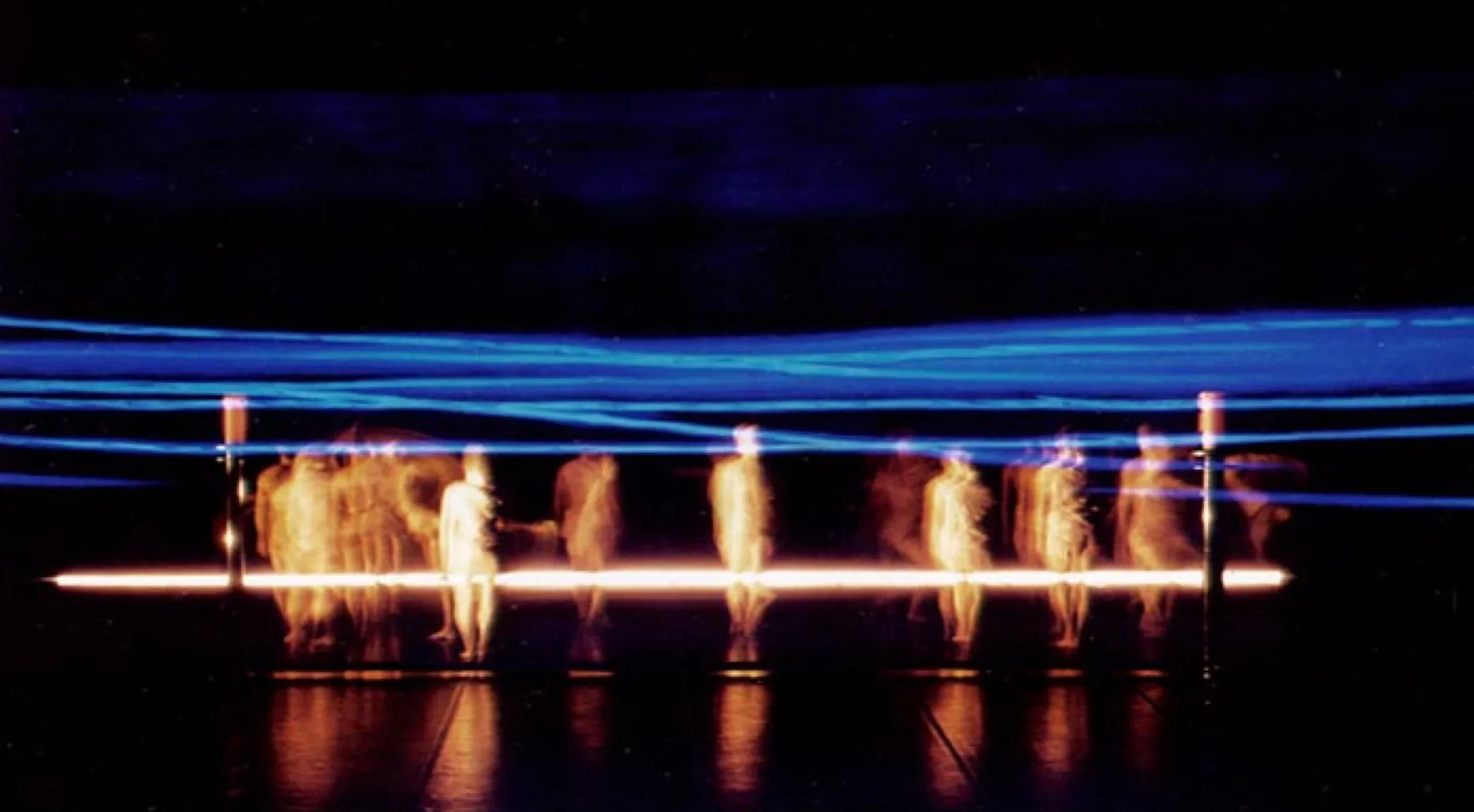
Inverse kinetic installation by Christopher Bauder
Another central aspect of this tension relates to the idea of risk. Few concepts appear as frequently in contemporary discourse as the valorization of boldness. Curators speak of experimentation, institutions claim to support “challenging” works, galleries celebrate innovative projects… Yet the sector’s economic reality imposes clear limits on the type of risk that can be effectively absorbed. The system accepts calculated, controlled and predictable risks. It accepts works that generate a sense of radicality without jeopardizing relevant financial, institutional or political interests.
In this context, art often begins to operate within a safe zone of transgression. Social issues can be addressed as long as they do not cause significant ruptures with funders. Critiques of capitalism can circulate comfortably within fairs sponsored by large economic conglomerates. Discourses on inequality can coexist without major conflicts at events frequented by global elites. The result is a peculiar form of institutionalized radicalism, in which criticism exists but rarely threatens the foundations that sustain its own circulation. Artists find themselves at the center of this contradiction. Contemporary discourse insists on the importance of authenticity, subjectivity and creative freedom. However, there is an unwritten set of expectations that delineates which forms of authenticity are considered acceptable. Political engagement is expected, but not excessive confrontation; vulnerability is expected, but not instability; criticism is expected, but not necessarily the direct naming of the structures responsible for the denounced problems. The cultural system shows interest in urgent discourses, provided their consequences remain manageable.
This condition produces a phenomenon of diffuse self‑censorship that is hard to identify. It is not necessarily a matter of explicit prohibition or direct institutional repression. It is an environment in which artists, critics and curators intuitively understand which positions favor circulation and which may result in isolation. As in many contemporary professional fields, maintaining relationships has become central to survival in the system. Direct criticism often yields to strategic diplomacy. At the same time, a significant transformation in the function of art criticism can be observed. Historically, criticism occupied an intellectual mediation role between artistic production and the public sphere. Its aim was not only to describe works but to evaluate, contextualize and confront them. In recent decades, however, the expansion of cultural‑marketing logics has profoundly altered this landscape. Many specialized outlets have come to depend on privileged access to artists, galleries and institutions. Consequently, criticism often approaches promotion.
The gradual replacement of critical judgment by constant celebration creates an environment where almost everything is presented as relevant, innovative or transformative. If everything is exceptional, nothing is truly exceptional. An excess of validation weakens the ability to distinguish between significant production and production that is merely well positioned institutionally. Critical debate yields to the construction of atmosphere. Analysis is replaced by perception management.
In this context, curators are taking on roles increasingly similar to brand managers. Their work remains intellectually significant, but it also begins to address demands for institutional positioning, fundraising, and public visibility. Exhibitions cease to be merely spaces for conceptual investigation and become strategic platforms for reputation building. The same process occurs with galleries, which now operate simultaneously as cultural agents, market enterprises, and experience producers. This transformation helps explain why representation and transformation are often conflated in contemporary debate. The increase in the diversity of voices, perspectives, and identities within the art system represents an important and necessary achievement; however, representation does not automatically equate to structural change. The inclusion of new participants within existing institutions does not necessarily alter the rules that govern those institutions. In many cases, the system expands its diversity without significantly modifying its fundamental mechanisms of power distribution.
The same applies to discourse. Contemporary art has become extremely sophisticated in producing critical language. Terms such as decoloniality, sustainability, inclusion, historical reparations and social justice occupy a central position in exhibitions, catalogues and institutional programmes. These discussions are essential and often yield concrete advances; however, there is a risk that the very circulation of discourse is mistaken for effective transformation. Talking about change is not the same as effecting change, and perhaps the deeper question is precisely the relationship of contemporary art to its own capacity for intervention. For much of the twentieth century, art was understood as a potentially destabilising force. Artistic movements sought to break conventions, challenge dominant values and generate new modes of perception. Even when their ambitions were utopian, there was a shared belief that art could alter the way individuals and societies understood the world.
Today, that confidence seems more fragile. Not because artists have lost creative potency, but because the cultural system itself has become extraordinarily efficient at absorbing dissent. Disruptive ideas are quickly incorporated into the institutional circuit. Marginal languages become trends. Resistance aesthetics turn into cultural assets. The speed with which the market captures and redistributes innovation reduces the shock potential that once characterized many artistic movements. In this sense, the main crisis of contemporary art may not be economic, aesthetic or technological. It may be a crisis of belief. A crisis concerning the field’s ability to once again believe in its own transformative power. It is not about returning to romantic narratives of the artist as a revolutionary figure, but about questioning how far the current system still allows art to produce genuine discomfort, real conflict and structural transformation.
The challenge becomes even more relevant in a historic moment marked by the expansion of digital platforms, the acceleration of attention cycles, and the transformation of virtually every cultural experience into shareable content. Works of art now compete with endless streams of images, opinions and stimuli. In this environment, there is constant pressure for artistic production to be instantly shareable, understandable and consumable. Platform logic favors rapid circulation, while art often requires time, ambiguity and reflection. When a work is primarily conceived as content, something essential is lost. Content seeks engagement. Art, in its most radical potential, seeks perceptual transformation; content, on the other hand, seeks attention retention. Art may demand a slowdown, while content tends to confirm expectations; meaningful art often arises precisely from its ability to frustrate them.
Therefore, the central issue is not merely who participates in the artistic system or how it allocates resources, but an understanding of what kind of cultural imagination is being produced and encouraged. If art wishes to continue claiming public relevance, it will need to confront its own institutional contradictions with the same critical intensity it applies to society's contradictions. It must recognize that openness is not just a narrative but a practice, that diversity is not merely representation but a redistribution of power, that risk is not only curatorial language but a willingness to accept consequences.
The history of art shows that its most significant moments arise precisely when it stops confirming consensuses and begins to tension them. When it abandons the comfort of predictability and embraces the complexity of conflict. When it refuses to function merely as an elegant mirror of the present and returns to act as an instrument of critical inquiry.
Complete TV · Reels
At Gagosian @gagosian in New York, the exhibition Negative Sculpture brings together two recent works by Michael Heizer and revisits an investigation
See on InstagramFrom Complete



More from Sarah Rocksane Araujo
View profile


Latest from Complete
 CultureMaja Petrić: the artist who wrote her own artificial intelligence
 InnovationLight has become a building material
 The CoverBrazil still gives little recognition to genuinely Brazilian authorial fashion.
 FashionFashion and the addiction of evaporation
 DesignAnton Berkasov plays his own art as one would play an instrument
 The Cover"I'm more afraid of being bored than of trying something new"
 BeautyBORNTOSTANDOUT arrives in Brazil