

Ryszard Kaja: the radicalism of form and of visual narrative
A direct descendant of the Polish School of Posters, Kaja inherited from his father, Zbigniew Kaja, a commitment to reinventing the format.
Words by
Words by Gilles Pedroza Leite
Design and Innovation
Listen to this story
There are designers who go beyond the function of the poster and raise it to an aesthetic manifesto. Ryszard Kaja was one of them. His name echoes not only as one of the most prolific creators of contemporary Poland, but as an artist who understood design as a radical language, a territory of experiment without concession.
A direct descendant of the Polish School of Posters, Kaja inherited from his father, Zbigniew Kaja, a commitment to reinventing the format. But where the earlier generation consolidated a graphic canon, Kaja worked in rupture. His process was an anarchic laboratory: "I used everything: pen, pencil, ink, coloured paint, gouache, coffee grounds, tea, ash, everything around me, not just the computer". The digital did not limit him, nor did the traditional restrict him. Every material was a sign, every texture a discourse.
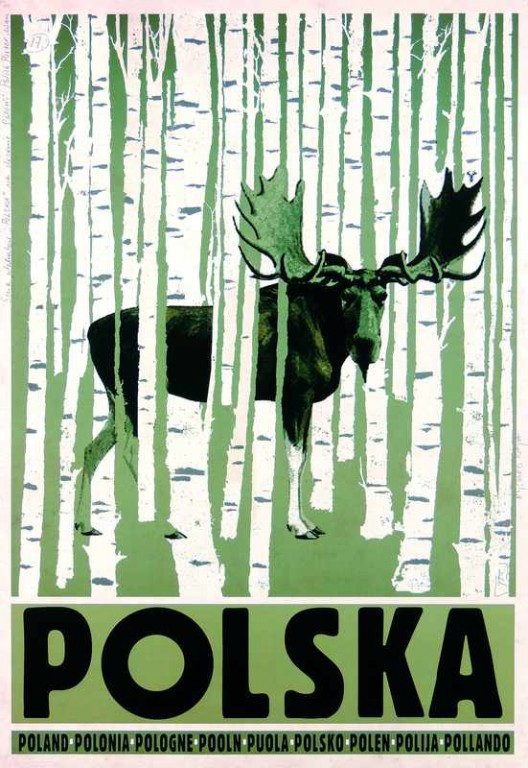
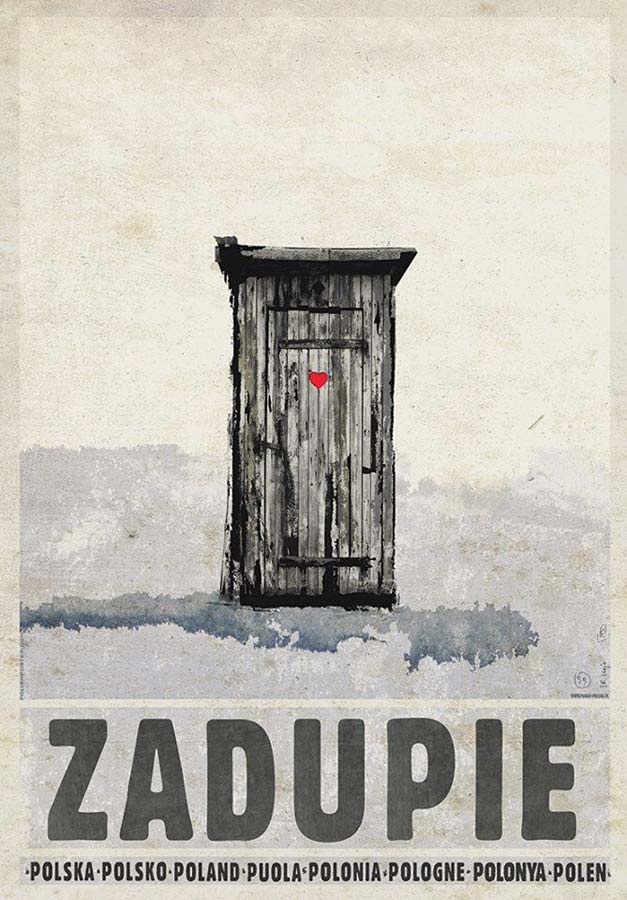
The "Poland" series sums up that approach. Wrongly classified as a set of tourist posters, it reveals itself as an emotional and identitary cartography. Every poster is a subjective cut of Polish territory, an atlas of pictorial memories. Silesia, for instance, is represented not as a point on a map, but as a mosaic of visual codes: red windows, industrial chimneys, modernist architecture of the 1920s. Documentary rigour gives way to sensory evocation, turning landscapes into narratives.
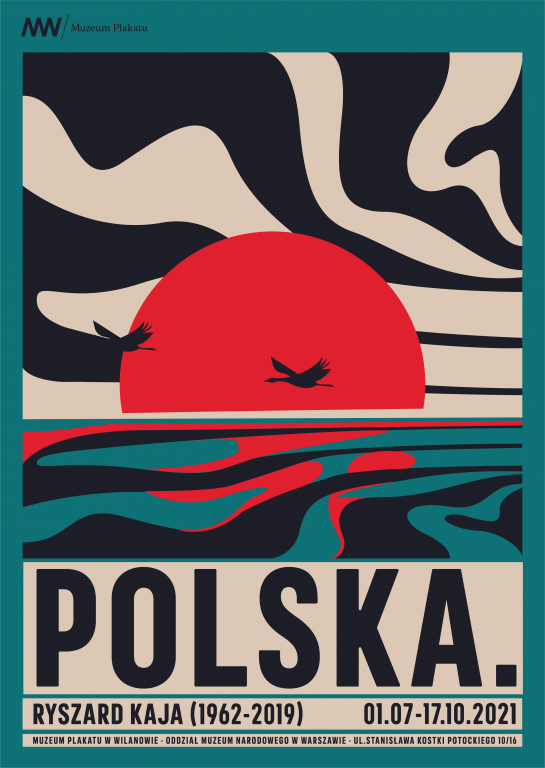
That aesthetic radicalism also shows in the posters that deconstruct cultural symbols. Łódź emerges as the epicentre of abstraction, referencing Mondrian and Katarzyna Kobro. Bolesławiec is reduced to the pattern of its vernacular ceramics. Kurpie and Zalipie are translated into stylised folkloric gestures. The posters devoted to Polish geography reconfigure mountains and valleys with an almost metaphysical eye: Zakopane appears in minimalist distillation, the Tatra Mountains become pure symbols, while the Table Mountains take on an orientalising varnish, evoking Japanese woodcuts.
It is in the play between irony and affection, however, that Kaja reaches his greatest force. Posters such as the one for Pacanów, with its iconic goat, or for Szczebrzeszyn, immortalised by a beetle, are playful exercises in design, where humour intertwines with a critique of national identity. Kaja explores cultural signs not as nostalgic fetishes, but as foundations for a contemporary discourse.
His posters were only one facet of his work. In theatre and opera, Kaja redefined set design as a space of total immersion. His debut, in 1989, with Victor Hugo's Hernani, opened a path in which more than 200 productions would carry his visual signature. What sets his work apart? An unshakeable commitment to the image as a dramatic force. Inspired by the exuberance of the Baroque, he carried onto the stage a pictorial aesthetic that refused literal realism. The costumes, in turn, continued the tradition of the "painted costume" of Zofia Wierchowicz and Krzysztof Pankiewicz, where the two-dimensionality of the sketch materialised in the three-dimensionality of the scene without losing its artistic essence.
In dramatic theatre, his set designs for A Midsummer Night's Dream (Shakespeare), Happy Days (Beckett) and The Mirror with Two Faces (Miller) put the limits of theatricality under tension. In opera, his reading of Madame Butterfly (Puccini), Carmen (Bizet) and Rigoletto (Verdi) gave the classics an aura of visual renewal. His creations were not mere supports for the action, but protagonists in themselves.
Ryszard Kaja did not see design as a utilitarian tool, but as a field of subversion. Every poster, every set, every costume was a visual manifesto, a gesture of resistance against predictability. His legacy is not merely an archive of images, but testimony that aesthetics, taken to its last consequences, is in itself a revolutionary act.
Complete TV · Reels
The Uruguayan artist Mauro Cosenza @mauro_cosenza, trained in circus and physical theatre, presented Neo Botanica at Load Gallery @load.gallery
See on InstagramFrom Complete




More from Gilles Pedroza Leite
View profile


Latest from Complete
 FashionFORCA Studio at SPFW N61: Forca X, Bridgestone tire and punk leather
 DesignTomie Ohtake House‑Studio presents Zanine Caldas
 The CoverIn the beginning, we couldn't even use the word handicraft.
 CultureThievery Corporation, 30 years: the Washington duo that originated in bossa nova
 InnovationLight has become a building material
 The CoverBrazil still gives little recognition to genuinely Brazilian authorial fashion.
 BeautyBORNTOSTANDOUT arrives in Brazil